
Lusha and Cognism both sell B2B contact data. One hands you a number fast. The other hands you a campaign.
Both will get you a phone number. The difference is what you're trying to build after that. Lusha lives in your browser. You spot a prospect on LinkedIn, click the extension, and have an email before the page finishes loading.
Cognism lives in your workflow. You build target lists by region and role, filter out anyone on DNC registries, and push compliant contacts into sequenced outreach.
Some teams buy Cognism and wonder why they're paying for workflow they don't use. Some buy Lusha and realize they need more structured, compliance-heavy workflows for global outreach.
Both platforms deliver contact data. They just deliver it to different people doing different jobs. Here is how to know which one belongs on your stack before you sign another contract.
Key Takeaways:
Lusha is perfect for small to mid-market sales and marketing teams that need fast, verified contact enrichment without complex setup or workflows. It excels at quick prospecting and integrating directly with CRMs and outreach tools. However, advanced features like intent data and DNC filtering require Premium or Scale plans, and credit costs add up with volume.
Cognism is ideal for global outbound teams that require GDPR-compliant, multi-region prospect lists and automation for campaign-ready outreach. Its strength lies in legal compliance, verified global leads, and multi-channel targeting. The trade-off is higher upfront cost and limited APAC coverage.
Teams that want verified contact and company enrichment without managing multiple platforms or compliance workflows can consider FullEnrich, which offers multi-provider waterfall enrichment on a pay-for-results model.
Lusha vs Cognism: Side-by-Side Comparison
Here's a quick comparison of Lusha and Cognism to help you understand how they differ in data coverage, compliance, automation, and suitability for B2B teams.
Attributes | Lusha | Cognism |
|---|---|---|
Best For | Small to mid-market sales and marketing teams needing fast contact enrichment | Global outbound teams needing GDPR-compliant lead generation and verified prospect lists |
Core Focus | Quick contact enrichment and prospecting | Compliance-first global lead generation and multi-channel outreach |
Primary Users | SDRs, marketing ops, small sales teams | SDRs, sales leaders, marketing ops, and global GTM teams |
Data Source | Aggregated public and proprietary B2B contact data | Aggregated global B2B datasets and proprietary sources |
Automation Level | Comprehensive on Premium/Scale plans (intent filtering, email sequences); basic on Pro plan | Moderate; list building, enrichment, and segmentation for campaigns |
Pricing Model | Subscription-based; starts at $29.90/month | Quote-based; starts around ~$15,000 yearly platform fee + ~$1,500 per user |
Integration | CRM integration (Salesforce, HubSpot), API access | CRM integration (Salesforce, HubSpot), outreach tools |
Data Compliance | GDPR-compliant; EU-focused enforcement | GDPR and CCPA compliant |
What is Lusha?
Lusha is a fast, user-friendly B2B data enrichment platform that helps sales and marketing teams quickly access verified contact information. It provides emails, phone numbers, and company details through a browser extension, SaaS dashboard, and API, allowing users to enrich leads on the go or in bulk. Lusha is ideal for teams that prioritize speed, ease of use, and direct CRM integration.
What is Cognism?
Cognism is a GDPR-compliant global lead generation and B2B data platform. It provides verified emails, direct dials, and enriched company and contact data for multi-channel campaigns. Cognism emphasizes compliance, global reach, and outbound-ready prospect lists for international sales and marketing teams. It is suitable for mid-market to enterprise teams expanding into multiple regions and needing structured, legally safe outreach workflows.
What Services Do Lusha and Cognism Offer?
Services are what you actually get from the platform—the outputs, deliverables, and solutions that solve specific business problems. Lusha and Cognism package their capabilities differently based on who they're built for.
Services Offered by Lusha
Lusha delivers fast, verified contact data through channels that fit into existing workflows.
Contact enrichment on demand. Append emails, phone numbers, and company details to individual leads or entire lists. The core service is getting you accurate contact information when you need it.
Browser-based prospecting. The extension lets you pull contact data while browsing LinkedIn or company websites. This is the entry point for most users—search, find, enrich, move on.
Bulk data processing. Upload CSV files to enrich hundreds or thousands of contacts at once. Useful for cleaning up existing databases before campaigns.
CRM synchronization. Push enriched contacts directly into Salesforce, HubSpot, or other CRMs. The service is about keeping your existing tools populated with clean data.
API access for custom workflows. Programmatic enrichment for teams that need to build data into internal tools or automate processes. (Available on Scale plans only)
Services Offered by Cognism
Cognism delivers structured, compliant prospect lists designed for multi-channel outbound campaigns.
Global prospect list generation. Build targeted lists of verified emails, phone numbers, and company data across multiple regions. The service is list creation, not just contact lookup.
Compliance-ready data delivery. Every lead comes with GDPR and CCPA safeguards baked in. The service includes legal protection, not just contact information.
Segmented audience building. Filter prospects by industry, role, company size, location, and other firmographic criteria. The output is a refined audience ready for campaign targeting.
Campaign-ready contact packages. Pre-validated leads optimized for email, phone, and LinkedIn outreach. The service reduces the work your team does to verify before reaching out.
Performance analytics and reporting. Track lead quality, engagement metrics, and campaign effectiveness. The service extends beyond data into insights about how that data performs.
What Are the Key Features of Lusha and Cognism?
Both platforms will get you contact data. The difference is what happens after you hit search. One drops you into a simple form and gets out of your way. The other opens a workspace with filters, compliance toggles, and campaign tools. The features below show you which environment your team will actually work in every day.
Key Features of Lusha
Lusha's features prioritize speed and simplicity. The design allows for rapid enrichment or full-scale prospecting within the dashboard.
Real-time verification on every lookup. Each email and phone number is checked at the moment of request. You're not relying on a static database.
One-click LinkedIn enrichment. The browser extension adds an overlay to LinkedIn profiles. Click once, get contact data, move to the next prospect.
Credit-based usage tracking. A visible counter shows remaining credits. Teams can monitor consumption without digging through reports. Credit consumption: 1 credit per email, 5 credits per phone number, 1 credit per CSV export (up to 25 rows).
Minimal dashboard design. The interface shows recent activity, remaining credits, and basic search. No menus, no complex settings, no learning curve.
Quick CRM sync toggle. Connect Salesforce or HubSpot with a few clicks. Enriched contacts flow into your CRM without manual export-import cycles.
Bulk upload interface. Drag and drop CSV files, map fields, and trigger enrichment. The process is designed to finish in minutes, not hours.
Intent data and advanced features. Available only on Premium and Scale plans. Includes job-change alerts, technographics, and API access.
Key Features of Cognism
Cognism's features focus on control, compliance, and campaign structure. The design assumes you need repeatable processes, not just occasional lookups.
ICP filtering and segmentation. Define ideal customer profiles using multiple criteria—industry, revenue, employee count, technology stack, job function. Build once, reuse across campaigns.
Compliance suppression tools. Automatically filter out contacts on Do-Not-Call lists or those who have opted out. The feature reduces legal risk without manual oversight. **** Includes 14 international DNC lists.
List building workspace. A dedicated interface for constructing prospect lists. Save searches, refine criteria, and export directly to outreach tools.
Campaign readiness indicators. Visual flags show which contacts are fully enriched, which need verification, and which are ready for outreach. Removes guesswork from list handoffs.
Multi-channel export options. Send lists to email sequences, dialers, LinkedIn campaigns, or CRM. The feature assumes you're not just collecting data—you're acting on it.
Activity timeline tracking. See when prospects were contacted, which messages they opened, and how they responded. The feature connects data to engagement history.
Team usage and permissions. Control who can access which lists, export contacts, or modify compliance settings. Built for teams with structure, not solo users.
How Accurate Is the Data from Lusha and Cognism?
Data accuracy is critical for successful outreach, engagement, and ROI. Lusha and Cognism take different approaches: Lusha prioritizes speed and verified contact details, whereas Cognism emphasizes compliance, global validation, and multi-channel readiness.
Lusha Data Accuracy
Lusha is ideal for teams seeking fast, verified leads for immediate outreach, particularly in the US and EU markets.
Email and phone verification: Provides real-time validated contact information to reduce bounces. The company claims 95% email accuracy and 90% phone accuracy .
Primary US/EU focus: Highest accuracy in North America and Europe; global coverage is limited. Users report weaker data quality in APAC and other regions .
Rapid updates: Frequent refreshes ensure data stays relevant for quick prospecting.
Single-source efficiency: Works best for small teams that need immediate access to accurate contact information.
Cognism Data Accuracy
Cognism performs best for teams needing legally compliant, globally verified leads for multi-channel campaigns.
Multi-source validation: Combines multiple datasets to verify global contact information. The platform's Diamond Data offers 87% connect rates for mobile numbers .
GDPR/CCPA compliance: Ensures all leads are legally safe for international outreach. Includes verification against 13 international DNC lists .
Regular updates: Automated enrichment and list refreshing maintain accuracy over time.
Outbound-ready optimization: Leads are pre-validated for email, call, and LinkedIn campaigns.
APAC coverage limitation: Users report that data depth in Asia-Pacific markets is thinner compared to US and EMEA coverage .
Which Platform Offers the Most Intuitive User Experience?
User experience determines how quickly your team can extract value from a B2B data platform. Lusha focuses on speed and simplicity, while Cognism focuses on structured workflows and compliance-driven prospecting.
Lusha User Experience
Lusha delivers a frictionless experience for SDRs and small sales teams. The browser extension allows you to extract contact details directly from LinkedIn or company websites in seconds. The dashboard is minimal, credit-based, and easy to navigate.
Onboarding requires little technical setup. You connect your CRM, define usage limits, and start enriching leads immediately. Bulk uploads and API access are straightforward, which makes Lusha suitable for teams that prioritize speed over deep configuration.
The platform minimizes complexity. However, it does not offer advanced campaign orchestration or deep analytics dashboards.
Cognism User Experience
Cognism has a more structured SaaS interface designed for global outbound workflows. You define ICP filters, segment audiences by geography and role, and generate campaign-ready lists. The UI supports advanced filtering and compliance controls.
Onboarding may take longer than Lusha because teams configure targeting rules, CRM sync, and compliance settings. Once configured, workflows become scalable and repeatable for multi-region campaigns. Cognism suits teams that value structured targeting, compliance assurance, and outbound readiness over instant enrichment.
Pricing and Plans
Pricing determines scalability, credit usage, and long-term ROI. Lusha uses a credit-based subscription model designed for flexibility, while Cognism uses a higher-tier subscription model focused on global, compliant outreach. Check Cognism pricing vs Lusha pricing in detail.
Lusha Pricing Plans
Lusha pricing scales based on contact volume and user count, with credits consumed for each action.
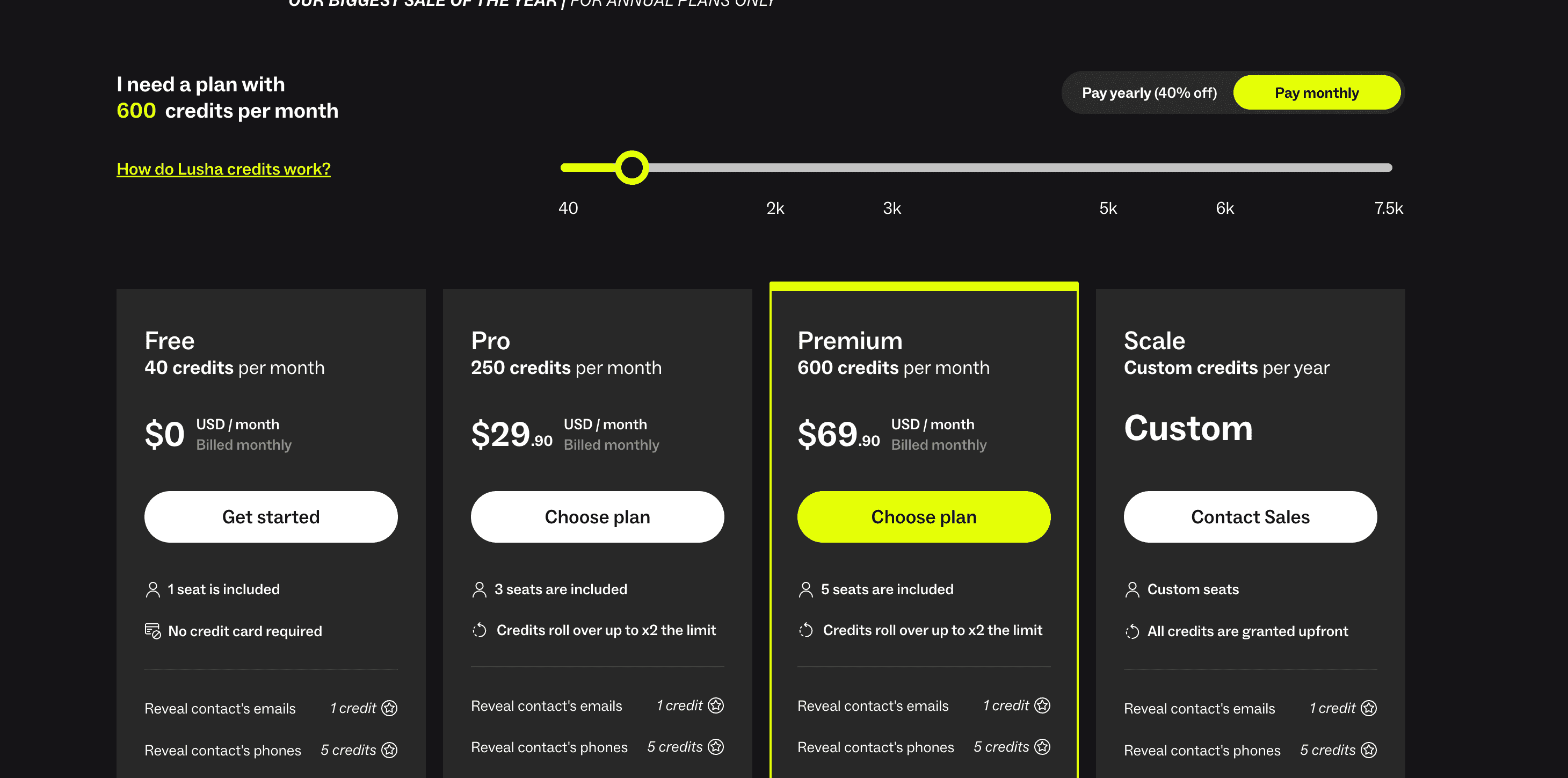
Plan | Price (USD per user/month) | Credits | Best for | Key limitations |
|---|---|---|---|---|
Free | $0 | 40/month | Testing the extension | Not suitable for active prospecting |
Pro | $22.45 (annual) or $29.90 (monthly) | Varies by plan selection | Solo users | Add-ons needed for integrations; DNC filtering not included |
Premium | $52.45 (annual) or $69.90 (monthly) | Varies by plan selection | Small teams (up to 5 seats) | No API or intent access in base plan |
Scale | Custom | Custom | Larger teams | Custom quote required; usage caps may still apply |
Credit consumption:
Email reveal: 1 credit
Phone reveal: 5 credits
Export to CSV: 1 credit (covers up to 25 rows)
Export to CRM: 1 credit
Credits roll over on monthly plans (up to a limit) but reset on annual plans. Unused credits expire at the end of your billing cycle unless you're on plans that permit rollovers.
Advanced features like intent signals, job-change alerts, technographics, and API access require higher-tier plans (Premium or Scale). DNC list filtering is only available on the most expensive packages.
Cognism Pricing Plans
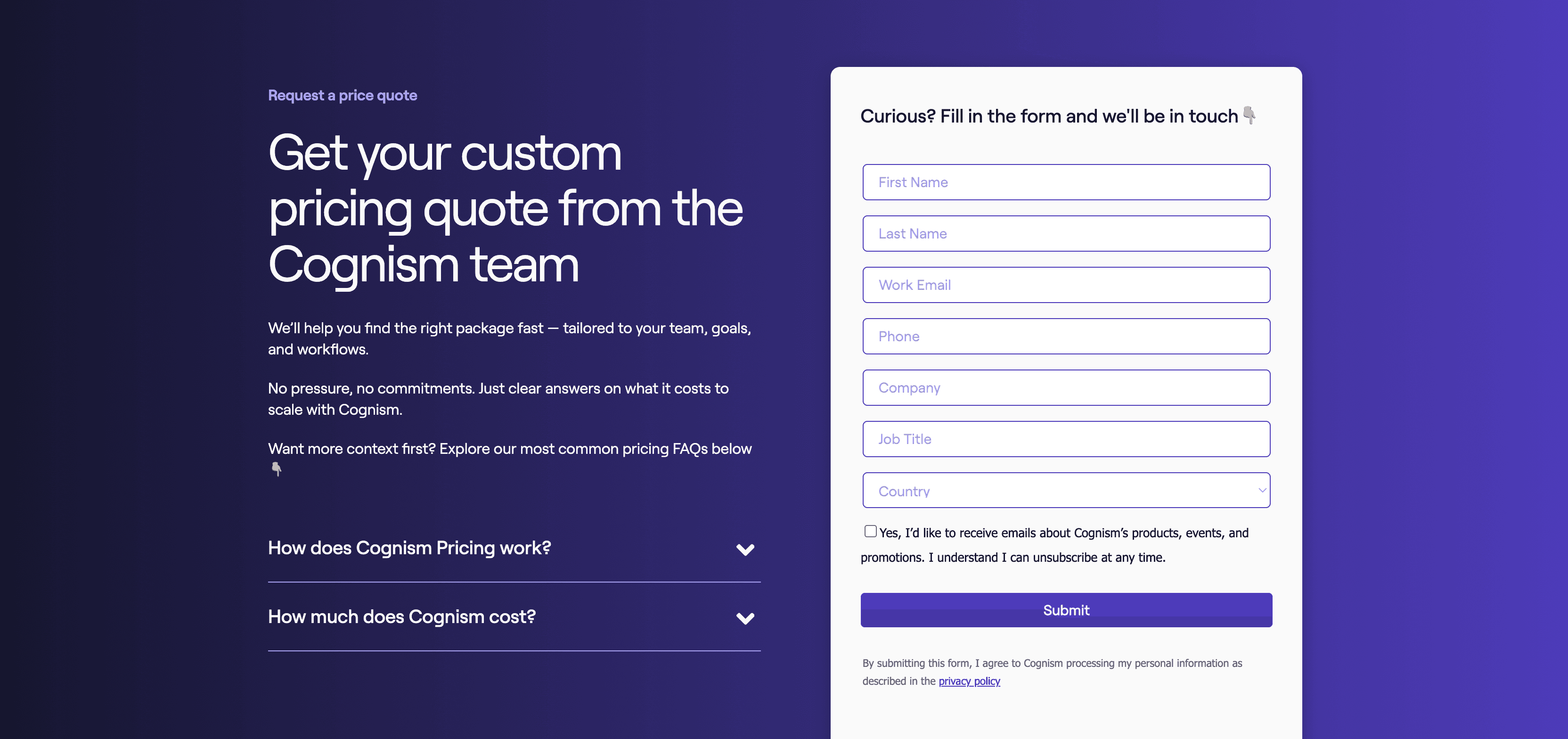
Cognism uses quote-based pricing with no publicly listed rates. All prices below are sourced from verified user reports on third-party platforms. **** Plan names may vary; these represent current market offerings.
Plan | Team Size | Annual Range | Main Features |
|---|---|---|---|
Grow (formerly Platinum) | 1-3 users | $1,500 – $10,000/year | Emails, direct dials, unverified mobiles, Chrome extension, CRM integrations |
Grow | 4-10 users | $10,000 – $18,000/year | Same + access to up to 25M contacts |
Elevate (formerly Diamond) | 1-3 users | $2,550 – $10,000/year | Grow + phone-verified mobiles (Diamond Data®), Intent Data (Bombora), Technographics, AI segmentation |
Elevate | 4-10 users | $10,000 – $25,000+/year | Same + access to up to 50M contacts, dedicated CSM |
Real-world example (Vendr data) :
5 users Grow = $22,513/year ($4,503 per user)
5 users Elevate = $37,498/year ($7,500 per user)
Additional costs:
Implementation fees: $500 – $1,500 one-time
Annual platform fee included but not detailed separately
All plans require annual commitment with advance payment
Cognism offers "unlimited" data access under a fair use policy of approximately 2,000 records per user per month. However, credits still apply for bulk exports (>25 contacts at once), API calls, and certain bulk operations.
What's included:
All plans: GDPR/CCPA compliant data, verification against 13 international DNC lists, ISO certifications
Elevate only: Phone-verified mobile numbers (87% connection rate), Bombora intent data, Diamonds-on-Demand service
The price difference between Grow and Elevate is primarily justified by phone verification of mobile numbers and access to intent data signals.
Who Should Use Lusha vs Cognism?
Choosing between Lusha and Cognism depends on your outreach scale, compliance requirements, geographic focus, and campaign structure. One prioritizes speed and simplicity, while the other prioritizes global compliance and structured outbound workflows.
Who Should Use Lusha?
Lusha fits teams that value speed, ease of use, and immediate access to verified contact details without managing large-scale campaign workflows.
SDRs and small sales teams: Need instant email and phone enrichment directly from LinkedIn or company websites without complex setup.
Startups and SMBs: Require affordable, credit-based prospecting with minimal onboarding friction.
Marketing teams: Need quick lead validation and enrichment before launching campaigns or passing leads to sales.
Teams operating mainly in the US/EU markets: Benefit from stronger regional data coverage and fast contact retrieval.
Organizations prioritizing simplicity: Prefer lightweight tools over structured outbound systems.
Who should NOT use Lusha:
Teams needing advanced intent data, job-change alerts, or technographics should budget for Premium or Scale plans.
Organizations requiring DNC filtering for compliance must select higher-tier plans.
High-volume prospectors may find credit costs add up quickly.
Also Read: 12 best Lusha alternatives in 2026
Who Should Use Cognism?
Cognism is well-suited for teams that require compliance-first prospecting, structured segmentation, and scalable outbound execution across international markets.
Mid-market sales teams: Require scalable prospect list building with consistent targeting logic.
Global GTM teams: Need GDPR/CCPA-compliant outreach across multiple regions and jurisdictions.
Marketing ops teams: Want advanced segmentation, filtering, and campaign-ready prospect lists.
Organizations prioritizing compliance: Need built-in privacy safeguards to reduce legal and regulatory risks.
Teams running repeatable outbound programs: Benefit from structured workflows and pre-validated global leads.
Who should NOT use Cognism:
Teams focused primarily on APAC markets may find coverage thinner than US and EMEA .
Small teams with limited budgets may find entry costs prohibitive.
Organizations needing only occasional contact lookups will overpay for workflow features they won't use.
Also Read: 12 best Cognism alternatives in 2026
Pros and Cons of Lusha vs Cognism
Evaluating advantages and limitations helps you align platform capabilities with your sales model, budget, and compliance requirements. Lusha focuses on speed and simplicity, while Cognism focuses on compliance and structured global outreach.
Lusha Pros and Cons
Lusha is best suited to tactical prospecting rather than structured outbound programs.
Pros
Provides instant contact access: Extract emails and phone numbers directly from LinkedIn or company websites.
Delivers simple onboarding: Minimal setup required; start enriching within minutes.
Uses credit-based pricing: Predictable monthly usage control for small teams.
Integrates easily with CRMs: Sync enriched contacts with Salesforce and HubSpot.
Supports API access: Enables bulk enrichment for internal workflows. **** Available on Scale plans.
Cons
Global data is broad but less specialized: Coverage is extensive, but often lacks the verified mobile density of region-focused competitors.
Advanced features like intent data, job-change alerts, and DNC filtering require Premium or Scale plans—not included in base Pro plan.
Segmentation is less granular: Filters are streamlined for speed, lacking the deep configuration options of enterprise-focused tools.
Provides limited campaign analytics: Focuses on enrichment rather than outbound orchestration.
Credit limits restrict scale: High-volume prospecting increases monthly costs. At 5 credits per phone number, costs add up quickly.
Cognism Pros and Cons
Cognism is designed for structured, compliance-driven outbound teams rather than individual rep-level enrichment use cases.
Pros
Ensures GDPR and CCPA compliance: Built-in privacy controls reduce legal exposure. Includes 13 international DNC lists.
Provides global lead coverage: Supports multi-region prospecting beyond US-centric datasets. **** Note: APAC coverage is thinner than US/EMEA.
Delivers campaign-ready lists: Pre-validated contacts improve outreach efficiency.
Supports advanced segmentation: Filter by role, industry, geography, and company size.
Scales for mid-market and enterprise teams: Structured workflows enable repeatable outbound growth.
Cons
Requires more onboarding time: Setup and segmentation configuration take longer than lightweight tools.
Costs more upfront: Higher entry pricing compared to credit-based enrichment tools.
May feel complex for small teams: Advanced filtering may exceed basic prospecting needs.
APAC coverage limitations require supplemental sources for teams targeting Asia-Pacific markets .
The Waterfall Alternative: FullEnrich
Here's where things get interesting. Full Enrich takes a completely different approach—instead of maintaining one massive database, it queries 20+ premium data sources in sequence until it finds valid contact information.
See how waterfall enrichment gets more coverage than either tool alone

Why this matters:
Higher match rates: 80%+ find rate versus 25-40% for single-source tools
Better accuracy: If one source has stale data, it moves to the next
Geographic consistency: Strong coverage across regions, not just one area
Pay for success: Only charged when enrichment succeeds
Triple email verification: Reduces bounce rates to nearly 1%
The math is simple: when you're not limited to one database, you find more valid contacts. And at $29/month starting price versus $52.45/user (Lusha) or $15,000+ platform fees (Cognism), the ROI often works out better.
👉 Ready to skip ahead? Get 50 free credits and test FullEnrich's waterfall enrichment against your current provider.
Which One Is a Better Option?
The better option depends on your team structure, geographic focus, and outbound maturity. Lusha and Cognism solve different stages of B2B prospecting. Compare more B2B data providers before deciding,
If your team prioritizes speed and simplicity, Lusha is the better option. It allows SDRs to instantly extract verified email addresses and phone numbers, enrich leads directly from LinkedIn, and sync contacts to the CRM without complex configuration.
It works best for startups, SMBs, and US/EU-focused teams that need fast enrichment rather than structured global campaigns. **** Just be aware that advanced features like intent data and DNC filtering require higher-tier plans, and credit costs can add up with volume.
If your team prioritizes compliance and scalable outbound workflows, Cognism is the stronger option.If you're exploring other compliance-first global data providers, review our breakdown of Cognism alternatives to compare additional enterprise-ready options.
It supports GDPR and CCPA-compliant prospecting, multi-region targeting, and advanced segmentation. It suits mid-market and enterprise teams running repeatable outbound programs across multiple geographies. **** The trade-offs are higher upfront cost and limited APAC coverage.
If your goal is strictly multi-source enrichment accuracy without heavy subscription commitments, a waterfall-based enrichment solution like FullEnrich may offer a more flexible alternative. It focuses on verifying contacts across multiple providers while avoiding long-term contracts or complex campaign systems.
Frequently Asked Questions (FAQs)
Which tool is better for LinkedIn-based prospecting?
Lusha performs better for LinkedIn-based prospecting. Its browser extension extracts contact details directly from LinkedIn profiles in seconds, making it ideal for SDR-led sourcing workflows.
Does Cognism provide better coverage outside the US?
Yes. Cognism offers broader international coverage, especially across EMEA markets, and embeds GDPR-compliant filtering into its global datasets. **** However, APAC coverage is more limited than US and EMEA.
Which platform reduces legal risk in EU outreach?
Cognism reduces legal exposure through built-in GDPR-compliant data handling and suppression processes. It is designed specifically for compliant international prospecting. **** Lusha offers GDPR compliance but DNC filtering requires higher-tier plans.
Do both platforms provide direct dials?
Yes. Both provide mobile and direct-dial numbers, but coverage varies by region. Cognism typically offers stronger international direct dial coverage.
Which tool is easier to deploy across a small sales team?
Lusha is easier to deploy. Setup takes minutes, requires minimal configuration, and does not require structured ICP filtering to start prospecting.
Can these tools support account-based sales strategies?
Cognism supports structured account segmentation and territory targeting more effectively. Lusha supports account-level enrichment but lacks advanced segmentation depth.
Which platform offers better scalability for global expansion?
Cognism scales better for global expansion due to its compliance-first architecture and multi-region dataset coverage. **** APAC-focused teams may need supplemental sources.
Do these platforms replace CRM data enrichment tools?
They complement CRM systems. Both integrate with Salesforce and HubSpot to enhance existing records rather than replace CRM functionality.
Which tool delivers faster ROI for startups?
Lusha often delivers faster short-term ROI for startups due to lower entry costs, credit-based pricing, and immediate usability. **** Cognism's ROI plays out over longer-term, structured outbound programs.
1. Data Quality & Accuracy: Who Actually Has Good Numbers?
Here's the uncomfortable truth about B2B contact data: marketing claims and field reality are often worlds apart.
Both Lusha and Cognism tout impressive accuracy stats in their sales decks. But user reviews? They tell a different story entirely.
Let's separate the sales pitch from what you'll actually experience when your SDRs start dialing.
Quick Comparison: Data Quality Metrics
Metric | Lusha | Cognism | Full Enrich |
|---|---|---|---|
Total Database | 280M+ contacts | ~25M contacts (Platinum) | 15+ sources queried |
Phone Accuracy (claimed) | 85% | 3x connect rates (UK/EMEA) | 80%+ via waterfall |
Email Deliverability | 98% claimed | Phone-verified focus | Triple verification |
Best Coverage | Global (stronger NA) | UK/EMEA mobiles | Global via multiple providers |
Verification Method | Batch updates | Diamond Data phone verification | Real-time across 15+ sources |
Credit Back on Bounces? | ❌ No | ❌ No | ✅ Only charged on success |
EMEA Accuracy | Mixed reviews, weaker | Strong in UK/EMEA | Consistent via waterfall |
The Marketing Claims vs. Reality Check
Lusha's pitch: 85% phone accuracy and 98% email deliverability across 280M+ verified contacts. They emphasize direct dials and mobile numbers for higher connect rates.
The reality? Users consistently report outdated numbers, mismatched contacts, and accuracy that varies wildly by region and industry. That "verified" badge doesn't guarantee the person still works there or that the number hasn't changed.
Cognism's pitch: Phone-verified Diamond Data with up to 3x better connect rates, especially for UK and EMEA markets. Every Diamond Data number has supposedly been checked for accuracy.
The reality? User feedback still flags incorrect information, regional data gaps outside their core markets, and freshness concerns that undermine those premium pricing tiers.
Truth bomb: "Verified" doesn't mean universal coverage or perfect accuracy. Both platforms struggle with the fundamental challenge—B2B data decays at 30-40% annually, and no amount of verification can fix a number that changed yesterday. 🎯
Where Each Platform Actually Delivers
Lusha performs best with North American coverage, broader global reach, and email deliverability (stronger than phone accuracy). Bombora-powered intent signals add targeting context for multi-channel campaigns.
But struggles with phone accuracy that doesn't match claims, weaker UK/EMEA mobile coverage, regional variance, and credits that burn faster than expected.
Cognism shines in EMEA markets—particularly UK mobile numbers—where phone-verified processes show real improvements. Those 3x connect rate claims hold up in London/Frankfurt. Extensive DNC compliance helps regulated industries.
But falls short outside EMEA where coverage thins dramatically. Smaller database limits reach, and despite verification, users still report incorrect info.
The Waterfall Alternative: Full Enrich
Here's where things get interesting. Full Enrich takes a completely different approach—instead of maintaining one massive database, it queries 15+ premium data sources in sequence until it finds valid contact information.
Why this matters:
Higher match rates: 80%+ find rate versus 25-40% for single-source tools
Better accuracy: If one source has stale data, it moves to the next
Geographic consistency: Strong coverage across regions, not just one area
Pay for success: Only charged when enrichment succeeds
Triple email verification: Reduces bounce rates to nearly 1%
The math is simple: when you're not limited to one database, you find more valid contacts. And at $29/month starting price versus $52.45/user (Lusha) or $15,000+ platform fees (Cognism), the ROI often works out better.
👉 Ready to skip ahead? Get 50 free credits and test FullEnrich's waterfall enrichment against your current provider.
🥇 Verdict: Data Quality & Accuracy Winner
🥇 Winner: Full Enrich — Waterfall enrichment across 15+ sources delivers the highest match rates (80%+) and most consistent global coverage. You only pay when enrichment succeeds.
🥈 Runner-up: Cognism — If you sell primarily into UK/EMEA and need verified mobile numbers, Cognism's Diamond Data legitimately delivers better connect rates in those specific markets.
🥉 Third place: Lusha — Broader global database is appealing, but accuracy doesn't match the marketing claims. Better for email than phone, but expect 60-70% real-world accuracy and pilot extensively before committing.
👉 Start free with 50 enrichments and see how many more verified leads you unlock
2. Pricing & Contracts: What You'll Actually Pay
Let's talk money—because pricing opacity in the B2B data space is legendary, and not in a good way.
Quick Comparison: Pricing Structure
Factor | Lusha | Cognism | Full Enrich |
|---|---|---|---|
Entry Price | Free plan available | No free plan | 50 free credits |
Paid Tiers Start | $52.45/user/month (annual) | ~$15,000/year platform | $29/month |
Pricing Model | Per-user + credits | Platform fee + per-user | Credit-based (all plans) |
Contract Length | Annual (25% discount) | Annual only | Monthly OR annual |
Pricing Transparency | ✅ Published | ❌ Custom quotes only | ✅ Published |
Credit Costs | Included in seat price | Unknown | 1 credit = 1 email, 10 credits = 1 phone |
Credit Rollover | ❌ No | Unknown | ✅ Yes (3-12 months) |
Hidden Fees | Credits burn faster than expected | Export fees, regional add-ons | ❌ None |
Cancel Flexibility | Annual lock-in | Difficult per reviews | Month-to-month available |
Lusha: Transparent Entry, Credits-Based Model
Lusha actually shows you pricing before you talk to sales—revolutionary in B2B.
The structure: Free plan with limited credits, paid tiers at $52.45/user/month (annual, 25% discount), per-user + credits model.
The catch? Credits disappear faster than you think. When enriching large lists or chasing direct dials, burn rates shock teams. Many underestimate needs for quality coverage—if Lusha only delivers 40% match rates in your region versus expected 70%, you're burning credits fast.
The 25% annual discount tempts, but locks you into year-long commitments based on estimates. Miss the mark and you're stuck overpaying or hitting limits.
👉 To learn more about Lusha pricing
Cognism: Enterprise Pricing, Hidden Costs
Cognism takes the classic enterprise approach: no public pricing, custom quotes only.
What we know from user reports: ~$15,000 annual platform fee, plus $1,500/user/year (Platinum), Diamond Data jumps to ~$25,000 platform + $2,500/user/year. Export credits and regional expansions cost extra.
The reality: Multiple users report surprise costs that weren't clear during sales. If you hate opaque pricing, Cognism will test your patience.
👉 To learn more about cognism pricing & Plans
Full Enrich: Predictable, Credit-Based Simplicity
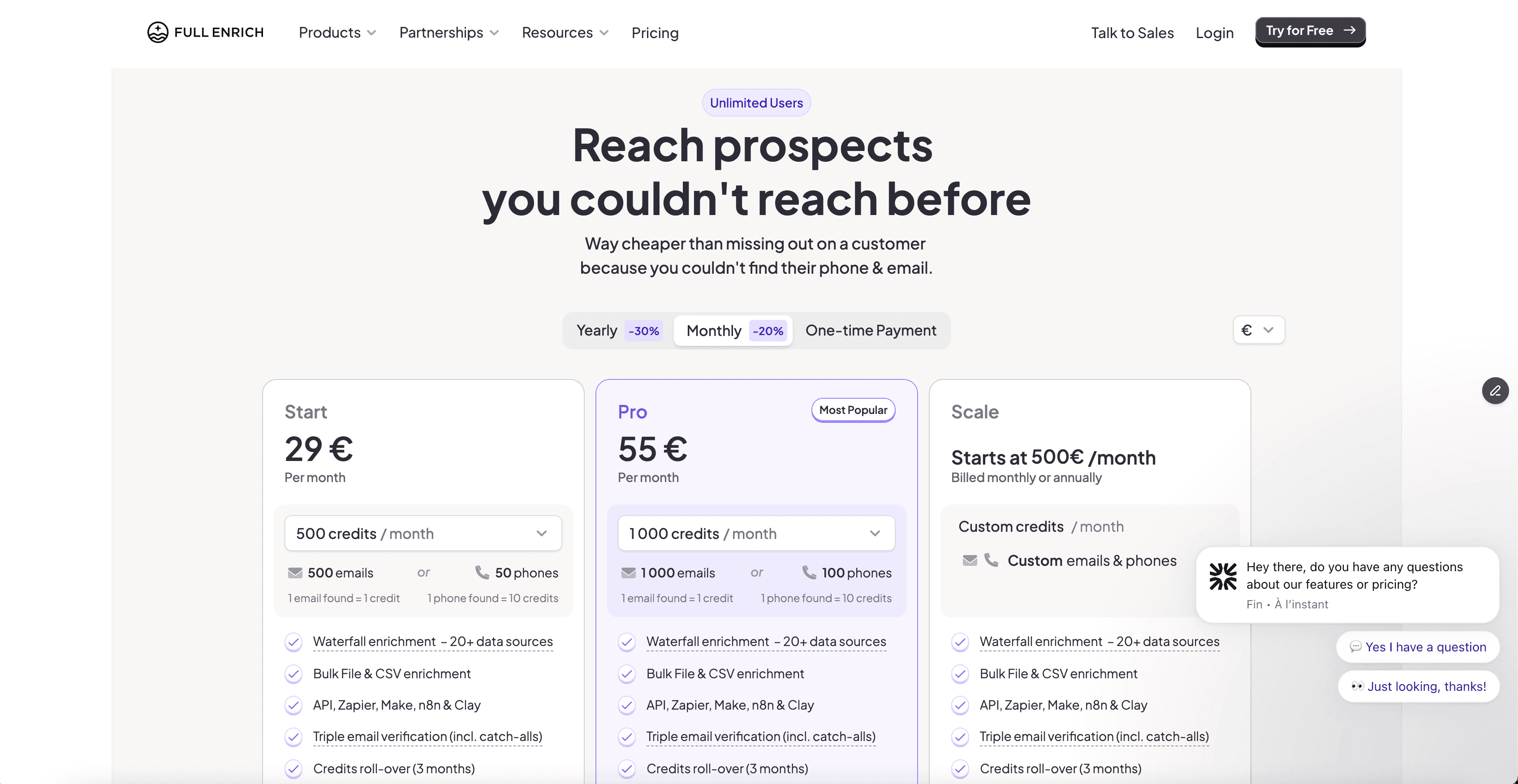
Full Enrich publishes actual prices and sticks to them.
The structure: Starter ($29/month, 500 credits), Pro ($55/month, 1,000 credits), Scale (custom $400-$50k/month). Credits: 1 email = 1 credit, 1 phone = 10 credits. Rollover: 3-12 months. API access on ALL plans.
👉 To learn more about FullEnrich pricing
The advantage: You only pay when enrichment succeeds. Can't find valid contact? Keep your credits. At 80%+ find rates, cost per successful contact often beats single-source providers.
Contract Gotchas and Lock-ins 💸
Lusha: Annual contracts with 25% discount bake in a year-long commitment. You're betting on your initial seat and credit estimates. Reducing headcount mid-contract? Too bad—you're stuck.
Cognism: Enterprise contracts are even less flexible. Typically 12-month minimums with platform fees that don't scale down. Several reviews mention difficulty getting out of contracts or adjusting terms when business needs changed.
Pro tip: Negotiate hard for quarterly reviews and adjustment clauses before signing. Both vendors push annual commitments hard, but you want escape hatches if your needs change or accuracy disappoints.
Full Enrich: Month-to-month option available. No annual lock-in required, though annual plans save 30%. If it's not working, you can cancel next month—not next year.
🥇 Verdict: Pricing & Contracts Winner
🥇 Winner: Full Enrich — Transparent pricing starting at $29/month, month-to-month options available, only pay for successful enrichment, and credits roll over. No hidden fees or surprise costs.
🥈 Runner-up: Lusha — Published pricing is a huge advantage. Starting at $52.45/user/month is reasonable for SMBs. But annual lock-in and fast credit burn create friction.
🥉 Third place: Cognism — Opaque enterprise pricing (~$15k+ platform fees) with surprise costs and annual commitments. Great if you have budget and need white-glove service, but zero transparency hurts.
3. Features & Capabilities: What Actually Moves the Needle?
Let's cut through the feature lists and focus on what actually helps your team book more meetings.
Both Lusha and Cognism pack their platforms with capabilities, but their strengths play to very different workflows and regions.
Quick Comparison: Key Features
Feature | Lusha | Cognism | Full Enrich |
|---|---|---|---|
Database Approach | Single source (280M contacts) | Single source (25M Platinum) | Waterfall (15+ sources) |
Intent Signals | ✅ Bombora-powered | ✅ Signal Data (hiring, funding) | ❌ Focus on enrichment |
Automation | Daily lead stream, sequences | AI Sales Companion | API automation |
Chrome Extension | ✅ LinkedIn prospecting | Unknown | ✅ LinkedIn enrichment |
CRM Sync | Native (Salesforce, HubSpot) | Not documented | API-first approach |
Email Sequences | ✅ Built-in | Unknown | ❌ Focus on data quality |
Phone Verification | Batch updates | Diamond Data (phone-verified) | Triple verification |
Meeting Recordings | ✅ Included | Unknown | ❌ N/A |
Job Change Alerts | ✅ Available | ✅ Signal Data | ❌ N/A |
DNC Checking | Basic compliance | ✅ Extensive DNC checks | Basic compliance |
Unlimited Users | ❌ Per-seat pricing | ❌ Per-seat pricing | ✅ All plans |
Lusha: Automation-First with Intent Signals
Lusha's biggest differentiator is its automation layer built on top of a massive 280M+ contact database.
What sets it apart:
Daily lead stream that auto-curates prospects from live signals, your CRM data, and lookalike audiences. You're not just getting static lists—you're getting prospects delivered to your inbox based on:
Bombora-powered intent signals (who's actually in-market)
Job change notifications
Lookalike modeling from your best customers
Workflow tools that smaller teams actually use:
Native email sequences inside the platform
CRM sync that actually works (Salesforce, HubSpot, Outreach)
Chrome extension for one-click prospecting while browsing LinkedIn
Meeting recordings to capture insights
Slack notifications for real-time alerts
The integrated stack advantage: For teams that want to move fast without stitching together five different tools, Lusha delivers an end-to-end prospecting solution.
But here's the reality check:
All those features don't fix the core data quality complaints. If you're calling dead numbers and emailing bounced addresses, does the automation really matter?
Users consistently report: "The platform is slick, but the data accuracy doesn't match the claimed 85% for phones. We're still wasting time on bad numbers."
Cognism: Phone Verification for EMEA Excellence
Cognism takes the opposite approach—fewer bells and whistles, but laser focus on phone-verified data quality for UK and EMEA markets.
What makes them different:
Diamond Data isn't just marketing fluff. It's mobile numbers that have been actively verified, not just scraped and stored. For teams selling into European markets where mobile penetration matters, this is a game-changer.
Users selling into London, Frankfurt, Paris, and other EMEA cities report: "The connect rate improvement is real. We're actually reaching decision-makers on their mobiles, not hunting through company switchboards."
Signal Data layer provides context for timing your outreach:
Hiring trends (company is growing)
Funding rounds (budget just opened up)
Technographics (they use your competitor's tech)
AI Sales Companion recommends contacts and speeds up prospecting workflows based on your activity patterns. Less manual searching, more intelligent suggestions.
Extensive DNC compliance with Do-Not-Call list checks—critical if you're operating in GDPR-heavy regions where violations can cost six figures.
Data-as-a-Service model with CSV/API enrichment means you can pump clean data directly into your existing workflows without manual exports.
The trade-offs?
First, the database is significantly smaller—up to 25M contacts in Platinum tier versus Lusha's 280M+. You'll hit coverage gaps faster, especially for niche industries or smaller companies.
Second, there's no free plan and pricing starts at enterprise levels (~$15k platform fees). You need serious budget and commitment.
Third, despite the phone verification claims, users still report incorrect information and regional gaps outside core EMEA markets.
The Enrichment-First Alternative: Full Enrich
Full Enrich doesn't try to be an all-in-one sales platform. It focuses on one thing: finding and verifying contact data better than anyone else.
What you give up:
Full Enrich doesn't include intent signals, email sequences, or meeting recordings. It's not trying to be your sales engagement platform.
If your primary need is accurate contact data and you already have tools for outreach and engagement, Full Enrich delivers better data at a fraction of the cost.
🥇 Verdict: Features & Capabilities Winner
🥇 Winner: Lusha — Most comprehensive feature set for teams wanting an all-in-one solution. Bombora intent, automation, sequences, and Chrome extension create a complete prospecting platform.
🥈 Runner-up: Full Enrich — If you care about data quality above all else, waterfall enrichment beats single-source providers. But you'll need separate tools for engagement.
🥉 Third place: Cognism — Phone-verified Diamond Data is legitimately valuable for EMEA markets, and Signal Data helps with timing. But smaller database and undocumented features make it harder to evaluate.
4. Integrations Ecosystem: Will It Play Nice with Your Stack?
Your contact data provider is only as good as its ability to connect with the tools you already use.
Let's see which platform actually integrates with your GTM stack versus making you build custom connections.
Quick Comparison: Integration Support
Integration Type | Lusha | Cognism | Full Enrich |
|---|---|---|---|
CRM Platforms | Salesforce, HubSpot | Not documented | API-first (all CRMs) |
Sales Engagement | Outreach, Salesloft | Not documented | API-first (all platforms) |
Automation | Zapier, Make, n8n | Not documented | Zapier, Make, Clay |
Slack Integration | ✅ Native | Unknown | Via automation |
API Access | ✅ Included | Enterprise add-on | ✅ All plans |
Chrome Extension | ✅ LinkedIn prospecting | Unknown | ✅ LinkedIn enrichment |
Data Warehouse | Unknown | CSV export | API for warehouse |
Documentation | ✅ Public docs | ❌ Sales team only | ✅ Public docs |
Lusha's Integration Ecosystem
Lusha delivers solid coverage for modern GTM stacks with native integrations you can actually use:
CRM connections:
Salesforce (bi-directional sync)
HubSpot (contacts, companies, deals)
Pipedrive
Sales engagement platforms:
Outreach (push contacts directly)
Salesloft (though less documented)
Automation flexibility:
Zapier (connect to 5,000+ apps)
Make (more complex workflows)
n8n (self-hosted automation)
Full API for custom workflows
Communication:
Slack (alerts for new leads, intent signals)
Chrome extension: Acts as a bridge between browsing and your CRM. While not technically an integration, it lets reps capture contact data from LinkedIn or company websites and push it straight to Salesforce or HubSpot.
For teams living in their browser during prospecting, this real-time sync saves hours of manual data entry.
What's missing?
Lusha doesn't publish native integrations with newer platforms like Apollo or modern data warehouses like Snowflake. You can likely connect through Zapier or API, but test the limits during your trial—credit-based models get expensive when enriching at scale through automated workflows.
Cognism's Integration Story (Or Lack Thereof)
Here's where things get murky.
The problem: Cognism doesn't publicly document their integrations anywhere in their marketing materials or help center.
This isn't necessarily a deal-breaker—many enterprise vendors handle integrations through custom implementations. But it's a massive red flag for transparency.
What we think based on their positioning:
As an enterprise solution with CSV/API enrichment and Data-as-a-Service delivery, Cognism likely supports major CRMs through API connections. But without published documentation, you're flying blind on:
Setup complexity
Sync frequency
Data field mapping
Which platforms are actually supported
Truth bomb: When a vendor doesn't publish their integrations, it usually means one of two things:
They're handling everything through generic API connections (which means more work for your team)
Their integration library is limited compared to competitors
Both scenarios add friction to your rollout. You'll need extra discovery calls just to understand if they connect with your existing stack.
Full Enrich's API-First Philosophy
Full Enrich takes a different approach: API-first design available on ALL plans, including the $29/month starter.
The advantage:
You're not locked into pre-built integrations. If you have development resources or use automation platforms, you can connect Full Enrich to anything:
Native automation platforms:
Zapier (pre-built actions)
Make (complex workflows)
Clay (revenue engine integration)
CRM enrichment:
API calls from Salesforce workflows
HubSpot property updates
Pipedrive record enrichment
Data warehouse integration:
Snowflake enrichment jobs
BigQuery batch processing
Custom ETL pipelines
🥇 Verdict: Integrations Winner
🥇 Winner: Lusha — Published documentation, native CRM connections, and pre-built automation integrations make implementation straightforward. No surprises.
🥈 Runner-up: Full Enrich — API-first on all plans (even $29/month) beats Lusha's flexibility. Perfect for technical teams or those using Clay/Make for automation.
🥉 Third place: Cognism — No public integration docs is a major transparency issue. You'll need sales calls just to learn what connects to your stack.
5. User Experience: What's It Like Day-to-Day?
The slickest UI in the world won't save you if your reps spend half their time correcting bad data or navigating clunky workflows.
Lusha: Built for Speed, Not Sophistication
Lusha wins the simplicity game. They display badges for "easiest to use" and "fastest implementation" right on their site—and user feedback backs this up.
What works:
Signup to first enriched contact in minutes
Chrome extension feels natural for LinkedIn prospecting
Daily lead stream pushes curated prospects to your inbox
Email sequences integrate smoothly without extensive training
What doesn't:
Simplicity sometimes means limited customization
Power users hit walls with granular filters
Credit-based system adds friction—reps think twice before revealing info
Cognism: Enterprise Polish with a Learning Curve
Cognism takes the white-glove enterprise approach. No public demos or detailed UI docs suggests curated onboarding.
What works:
AI Sales Companion reduces cognitive load with smart recommendations
CSV/API enrichment for programmatic control
Dedicated support team (G2 reviews praise responsiveness)
What doesn't:
No way to test before buying
Frequently needing support isn't a feature
Enterprise pricing locks you in before understanding UX fit
🥇 Verdict: User Experience Winner
🥇 Winner: Lusha — Speed and simplicity win for teams that want minimal training overhead. Chrome extension and automation are genuinely helpful.
🥈 Runner-up: Full Enrich — Simple interface, fast enrichment, clear credit tracking. Not as feature-rich but easier to master.
🥉 Third place: Cognism — White-glove service is nice if you have budget, but no public demos or trial means buying blind.
6. Support & Compliance: Are You Covered?
When you're pumping customer data through your GTM stack, compliance isn't optional—it's existential.
Quick Comparison: Compliance & Support
Factor | Lusha | Cognism | Full Enrich |
|---|---|---|---|
GDPR Compliant | ✅ Yes (certified) | ✅ Yes | ✅ Yes |
CCPA Compliant | ✅ Yes (audited) | ✅ Yes | ✅ Yes |
SOC 2 Type II | ✅ Yes | Unknown | ✅ Yes |
ISO Certifications | ✅ ISO 31700 | Unknown | ❌ No |
DNC Checking | Basic | ✅ Extensive | Basic |
Support Quality | Unknown (1.3 Trustpilot) | ✅ Praised in reviews | Responsive per reviews |
Help Center | Available | Available | ✅ Available |
Compliance Certifications
Lusha: GDPR (ePrivacyseal certified), CCPA (TrustArc audited), ISO 31700, SOC 2 Type II. Serious compliance stack.
Cognism: GDPR and CCPA aligned, extensive DNC list checking. Their real differentiator is operational compliance—audit-ready metadata and multi-jurisdiction DNC checks.
Full Enrich: GDPR, CCPA, SOC 2 compliant. Doesn't store data long-term (cleaner compliance posture).
Support Quality
Cognism: G2 reviews consistently praise "prompt support resolution" and dedicated success teams for enterprise accounts.
Lusha: Concerning 1.3/5 Trustpilot rating despite G2 praise. Support channels and quality metrics weren't documented in research.
Full Enrich: Responsive support per reviews, comprehensive help center, community engagement.
🥇 Verdict: Support & Compliance Winner
🥇 Winner: Cognism — Most robust compliance with extensive DNC checking and praised support quality. Worth the premium for regulated industries.
🥈 Runner-up: Full Enrich — Strong compliance without data storage concerns. Good support at accessible price points.
🥉 Third place: Lusha — Compliance certifications are solid, but Trustpilot rating and unclear support infrastructure raise concerns.
The Bottom Line: Which Platform Wins?
Here's my honest take after digging into all three platforms.
Lusha is the accessible option for global SMBs needing automation and intent signals. Starting at $52.45/user/month with transparent pricing and documented integrations makes it easy to test. But expect 60-70% real-world accuracy and weaker performance outside North America.
Cognism is the EMEA specialist for enterprise teams with serious budgets. If you're calling into London or Frankfurt, their phone-verified Diamond Data legitimately delivers better connect rates. But $15k+ platform fees, opaque pricing, and smaller database limit appeal outside their core markets.
Full Enrich solves the fundamental problem both platforms face: single-source data gaps. By querying 15+ sources sequentially, you get 80%+ match rates, better international coverage, and only pay for valid data—at a fraction of the cost ($29/month vs $52.45+ or $15k+).
My recommendation?
If you're tired of low match rates, bounced emails, and frustrated SDRs who can't reach prospects, try waterfall enrichment.
Start with 50 free credits from Full Enrich and compare the match rates to your current tool. Most teams see an immediate lift in contacts found—which translates directly to bigger pipeline.
Happy prospecting! 🎯
FAQ: Your Questions About Lusha vs Cognism
Which is cheaper—Lusha or Cognism?
Lusha is significantly cheaper with transparent pricing starting at $52.45/user/month (annual billing). Cognism doesn't publish pricing but reports suggest ~$15,000+ annual platform fees plus per-user costs, making it an enterprise investment.
Who has better phone data accuracy?
Cognism's phone-verified Diamond Data delivers stronger UK/EMEA mobile accuracy with claims of 3x higher connect rates. Lusha claims 85% phone accuracy globally but user reviews report mixed results. For maximum coverage across all regions, Full Enrich's waterfall approach queries multiple sources for 80%+ find rates.
Which has the bigger database?
Lusha has a much larger database with 280M+ contacts versus Cognism's reported 25M (Platinum tier). However, database size doesn't equal accuracy—Full Enrich's waterfall approach across 15+ sources often delivers better match rates despite not maintaining its own database.
Do they integrate with Salesforce and HubSpot?
Lusha offers native integrations with Salesforce, HubSpot, Outreach, and Zapier—all publicly documented. Cognism doesn't publish integration documentation, requiring sales conversations to confirm CRM support. Full Enrich provides API access on all plans for flexible integration.
Is there a free plan or trial available?
Lusha offers a free plan with limited monthly credits. Full Enrich provides 50 free credits to test waterfall enrichment. Cognism doesn't offer a free trial—you'll need to go through their sales process for evaluation access.
Which is better for international prospecting?
Full Enrich wins for consistent global coverage via waterfall enrichment across 15+ regional specialists. Lusha has broader global reach but accuracy varies by region. Cognism is specifically designed for UK/EMEA markets and may have significant gaps elsewhere.
What if I mainly need to enrich existing CRM data?
If your primary goal is cleaning and enriching existing CRM records rather than building net-new prospect lists, consider Full Enrich's enrichment-first approach. You'll improve data completeness at lower cost without paying for database access you won't use.



Other Articles
Cost Per Opportunity (CPO): A Comprehensive Guide for Businesses
Discover how Cost Per Opportunity (CPO) acts as a key performance indicator in business strategy, offering insights into marketing and sales effectiveness.
Cost Per Sale Uncovered: Efficiency, Calculation, and Optimization in Digital Advertising
Explore Cost Per Sale (CPS) in digital advertising, its calculation and optimization for efficient ad strategies and increased profitability.
Customer Segmentation: Essential Guide for Effective Business Strategies
Discover how Customer Segmentation can drive your business strategy. Learn key concepts, benefits, and practical application tips.