
Demandbase and Proxycurl address different data challenges within modern B2B revenue teams. Demandbase focuses on account-based marketing, buyer intent signals, and enterprise-level targeting.
Proxycurl focuses on raw data extraction, enrichment APIs, and developer-driven workflows. Sales teams, SDRs, recruiters, and RevOps leaders compare
Demandbase vs Proxycurl to decide whether they need strategic account intelligence or flexible, programmatic data access. The difference affects budget allocation, integration complexity, and how quickly teams can activate enriched data in outbound, recruiting, or account-based campaigns.
Important Note: As of July 2025, Proxycurl has officially shut down its operations following a legal settlement.
Key Takeaways
Demandbase provides a comprehensive, high-level control centre designed for marketing teams who need a "ready-to-use" platform for account scoring and targeting. This is a sophisticated dashboard that handles the heavy lifting of data visualization and campaign management.
Proxycurl serves as a high-performance engine for developers and technical recruiters who prefer to build their own custom tools. Instead of paying for a finished interface, you are buying access to a raw stream of public profile and company data that can be plugged directly into your own proprietary systems or specialized outreach workflows.
FullEnrich bridges the gap: FullEnrich eliminates the struggle of choosing between an expensive enterprise platform and a complex technical API. By running a live "waterfall" search across more than 20 premium data providers simultaneously, it delivers the elite accuracy of a high-end system with the flexibility of a pay-as-you-go tool.
Demandbase vs Proxycurl: Side-by-Side Comparison
Demandbase vs Proxycurl comparison becomes clearer when core attributes are evaluated side by side. The table below highlights practical differences that matter when choosing between account-based intelligence and API-first enrichment.
Attributes | Demandbase | Proxycurl |
|---|---|---|
Best For | Enterprise ABM teams targeting high-value accounts | Developers, recruiters, and growth teams need raw enrichment APIs |
Core Focus | Account-based marketing and intent-driven targeting | Programmatic data extraction and enrichment |
Data Source | First-party data, third-party intent data, and firmographic datasets | Public web data, LinkedIn-derived data, structured web scraping |
Primary Users | Marketing Ops, RevOps, enterprise sales teams | Developers, technical growth teams, recruiters |
Automation | Campaign automation within ABM workflows | API-based automation via custom workflows |
Technical Complexity | Moderate; marketer-friendly interface | High; requires API integration and developer support |
Pricing Model | Custom annual contracts typically start around $18,000–$32,000 per year | Usage-based pricing; entry plans typically start around $49 per month |
Data Compliance | Enterprise-grade GDPR and CCPA compliance controls | GDPR-aligned framework; compliance depends on implementation |
Customization Level | Custom segmentation, dashboards, and account scoring | Fully customizable enrichment workflows through API logic |
Support | Dedicated customer success manager for enterprise accounts | Technical documentation, email support, and developer assistance |
What is Demandbase?
Demandbase is an account-based marketing (ABM) and account intelligence platform built for B2B revenue teams. Demandbase identifies high-value accounts, tracks buying-intent signals, and aligns marketing and sales around prioritized targets. Demandbase combines firmographic data, behavioural intent data, and CRM insights to help teams focus on accounts that demonstrate genuine purchase intent.
Demandbase enables account scoring, audience segmentation, ad targeting, and pipeline tracking inside one platform. It integrates directly with platforms such as Salesforce, HubSpot, and Marketo, making it suitable for mid-market and enterprise organisations running structured ABM programs.
What is Proxycurl?

Proxycurl is a data enrichment API provider that extracts and structures people and company data from public web sources. Proxycurl delivers LinkedIn-based profile data, company information, employee details, and contact insights through developer-friendly REST APIs. Proxycurl focuses on raw data access rather than campaign orchestration or ABM strategy.
Proxycurl enables teams to build custom enrichment pipelines, automate prospect research, and power recruiting or outbound workflows programmatically. Proxycurl returns structured JSON responses that integrate into internal tools, CRMs, and growth systems.
What Services Does Demandbase and Proxycurl Offer?
Demandbase and Proxycurl offer different service categories. Demandbase provides account-based marketing, intent intelligence, and revenue orchestration tools. Proxycurl provides API-based data extraction and enrichment services. The difference lies in strategy versus infrastructure. Demandbase focuses on campaign execution and account prioritization, while Proxycurl focuses on raw data delivery for custom workflows.
Services Offered by Demandbase
Demandbase operates as an all-in-one execution suite, functioning more like a specialized marketing agency inside a software box than a simple data tool. It is designed to take the weight off your internal teams by providing a centralized command center that handles everything from the first "anonymous" website visit to the final sales hand-off.
Account-Based Advertising Service: Demandbase provides a native Demand-Side Platform (DSP) built strictly for B2B outcomes. Unlike generic ad networks, this service allows you to serve hyper-targeted impressions only to specific decision-makers within your target accounts.
Predictive Intent Analytics: This service monitors digital breadcrumbs across the web to identify which accounts are currently in an active buying cycle. By analyzing content consumption and search patterns, Demandbase flags "hot" accounts before they even fill out a form on your site.
Dynamic Website Personalization: Demandbase identifies anonymous corporate visitors in real-time and instantly customize your website's content to match their industry or specific company profile.
Data Integrity and Orchestration: This service acts as a continuous "cleaning crew" for your CRM and Marketing Automation platforms. It automatically normalizes, deduplicates, and enriches your existing lead data.
Services Offered by Proxycurl
Proxycurl functions as a high-octane "data-as-a-service" engine, designed for those who need raw, programmatic intelligence to fuel their own applications. It is not a dashboard or a marketing suite; it is a technical service that allows developers and growth engineers to pull massive amounts of public profile data with surgical precision.
Person and Company Enrichment API: Proxycurl provides a direct-access service that transforms a single LinkedIn URL or email into a rich, structured data profile.
Real-Time Profile Scraping: Unlike static databases that suffer from "data rot," this service triggers a live scrape of a public profile the moment you request it.
Contact Information Discovery: Proxycurl offers a dedicated lookup service to find professional email addresses and direct phone numbers for individuals and companies.
Bulk LinkDB Data Access: For organizations that need to do massive-scale analysis, Proxycurl provides access to "LinkDB," a structured dataset covering millions of global profiles.
Key Features of Demandbase vs Proxycurl
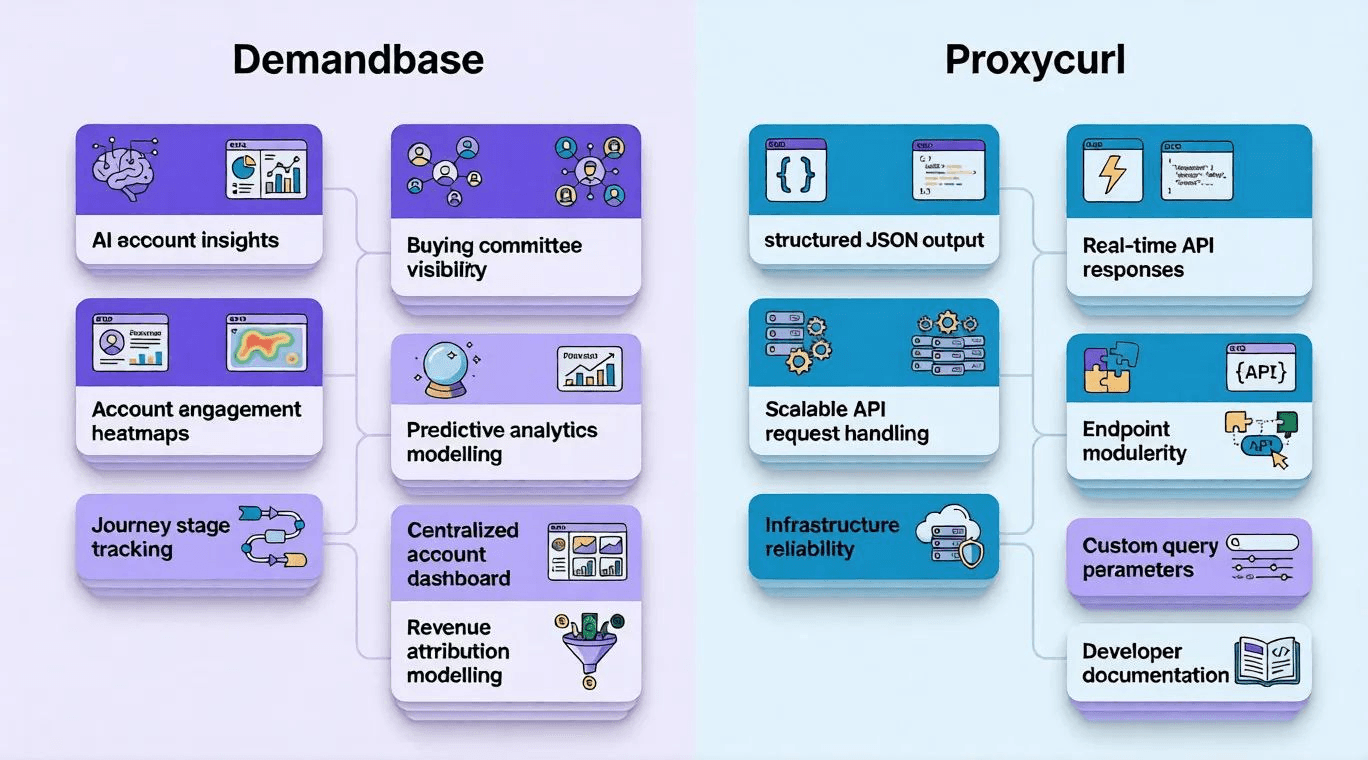
Demandbase and Proxycurl offer distinct feature sets because they address different problems. Demandbase focuses on account intelligence, predictive insights, and ABM optimization. Proxycurl focuses on structured data retrieval, enrichment flexibility, and developer control. The features below exclude previously listed services and highlight product-level capabilities.
Key Features of Demandbase
Demandbase provides advanced ABM and revenue intelligence features that support strategic decision-making:
AI-driven account insights: Demandbase analyses engagement signals to identify accounts with increased buying behavior.
Buying committee visibility: Demandbase maps multiple stakeholders within the same organization to reveal decision-maker clusters.
Account engagement heatmaps: Demandbase visualizes account activity across campaigns, content, and sales touchpoints.
Predictive analytics modelling: Demandbase forecasts the likelihood of account conversion based on behavioural patterns.
Journey stage tracking: Demandbase categorizes accounts by awareness, consideration, or decision stage.
Centralized account dashboard: Demandbase provides unified visibility across marketing, sales, and engagement metrics.
Revenue attribution modelling: Demandbase links account engagement to pipeline influence and closed-revenue impact.
Key Features of Proxycurl
Proxycurl delivers technical capabilities that support automation and structured data processing:
Structured JSON output: Proxycurl returns standardized data formats for seamless backend integration.
Real-time API response architecture: Proxycurl provides immediate enrichment results during outbound or recruiting workflows.
Scalable request handling: Proxycurl processes high volumes of API requests for large enrichment batches.
Endpoint modularity: Proxycurl allows selective API calls for people, companies, or employee lookups.
Infrastructure-level reliability: Proxycurl ensures uptime and consistent response times for production systems.
Custom query flexibility: Proxycurl enables filtering logic and parameter-based data retrieval.
Developer documentation access: Proxycurl provides technical documentation and endpoint references for implementation.
How Accurate Is the Data from Demandbase and Proxycurl?
Data accuracy directly impacts SDR productivity, campaign performance, and recruiting efficiency. Inaccurate firmographics reduce targeting precision. Outdated profile data lowers reply rates. Demandbase and Proxycurl approach data accuracy differently because their data models and update mechanisms differ.
Demandbase Data Accuracy
Demandbase excels at organizational intelligence, focusing on the big picture of a company rather than just individual contact details. Because it draws on massive datasets on firmographics and finances, its data on company size, revenue, and location are remarkably stable. Most users find its account-matching logic to be nearly flawless, which is why it maintains a strong 4.4/5 rating on G2.
Proxycurl Data Accuracy
Proxycurl prioritizes "live" data over static archives, often scraping public profiles in real time to ensure the information is up to date. This makes it a powerhouse for tracking fast-moving changes, such as job titles or new skills, that traditional databases haven't yet captured. However, because it pulls directly from the web, the quality is only as good as the source; if a user hasn't updated their profile, Proxycurl will accurately report that outdated info.
Which Platform Offers the Most Intuitive User Experience?
User experience shapes the speed of adoption, efficiency, and team productivity. Demandbase and Proxycurl deliver different experiences because one targets marketers and RevOps, while the other targets developers and technical teams.
Demandbase User Experience
Demandbase provides a marketer-friendly, visual interface designed for mid-market and enterprise ABM teams. Users access dashboards that display account engagement, intent signals, and predictive scoring without needing technical expertise. Campaign creation, segmentation, and reporting are all handled within the same platform, reducing reliance on engineers or external systems.
Proxycurl User Experience
Proxycurl offers a developer-centric experience optimized for API consumption. Users interact with Proxycurl primarily through REST endpoints, JSON responses, and integration documentation. There is a minimal graphical interface, as workflows are built programmatically or integrated into internal tools. Proxycurl prioritizes flexibility, real-time response, and volume scalability over UI simplicity. Teams using Proxycurl benefit from the ability to customize data pipelines, automate enrichment at scale, and embed data retrieval directly into recruiting, sales, or growth systems.
Pricing and Plans
Pricing is a critical factor when choosing between Demandbase and Proxycurl. Both platforms differ in structure, starting points, and flexibility, reflecting their respective target audiences and service approaches.
Demandbase Pricing Plans
Demandbase does not provide a public price list. Instead, its costs are negotiated based on your organization's size, required data modules, and total ad spend. r.
Standard Implementation (Estimated ~$18,000 - $30,000/year):. It is designed for mid-market companies that need a solid foundation for targeting specific accounts without the full suite of advanced advertising tools.
Enterprise Solution (Estimated ~$70,000+/year): It is built for large organizations that need to align their sales and marketing efforts across thousands of high-value accounts.
Proxycurl Pricing Plans
Proxycurl utilizes a straightforward credit-based system, allowing you to pay only for the data you actually consume. This model is ideal for teams that want to avoid heavy annual contracts and only need to pull data on an as-needed basis.
Pay-As-You-Go ($10 minimum): This is the ultimate entry point for individual developers. For a one-time purchase of $10, you receive 100 credits to test the API.
Annual Subscriptions (Starting at $49/month): For teams with predictable monthly needs, these plans offer a lower per-credit cost. The basic subscription provides 2,500 credits per month and goes way upto $2,000/month for Enterprises, which often requires 1.5 years contract.
Who Should Use Demandbase vs Proxycurl?
The selection between Demandbase and Proxycurl depends on team goals, technical resources, and campaign complexity. Each platform serves distinct user needs, making it essential to align the tool with specific workflows and organizational priorities.
Who should use Demandbase?
Best for marketing, RevOps, and enterprise sales teams running structured ABM programs.
Enterprise ABM teams: Companies targeting high-value accounts with coordinated marketing and sales outreach benefit from Demandbase’s account intelligence and intent insights.
Revenue operations and marketing ops: Teams that need unified dashboards, CRM integration, and reporting to measure pipeline impact find Demandbase effective.
Teams prioritising account-level strategy: Organizations that focus on identifying active buyers, segmenting accounts, and orchestrating campaigns gain value from built-in analytics and engagement insights.
Non-technical users: Demandbase is ideal for teams that prefer marketer-friendly interfaces and do not require developer resources for implementation.
Who should use Proxycurl?
Best for developers, recruiters, and growth teams needing programmatic data enrichment and workflow automation.
Technical growth teams: Teams building custom outbound pipelines, enrichment workflows, or automated lead scoring benefit from Proxycurl’s API-first approach.
Recruiters and sourcing teams: Proxycurl provides structured people and company data for candidate research and contact enrichment.
Companies needing real-time data: Teams requiring up-to-date profiles or company information on demand can improve accuracy with Proxycurl’s API.
Organizations with developer resources: Proxycurl requires engineering support to implement APIs, making it suitable for teams that can manage custom integrations.
Pros and Cons of Demandbase vs Proxycurl
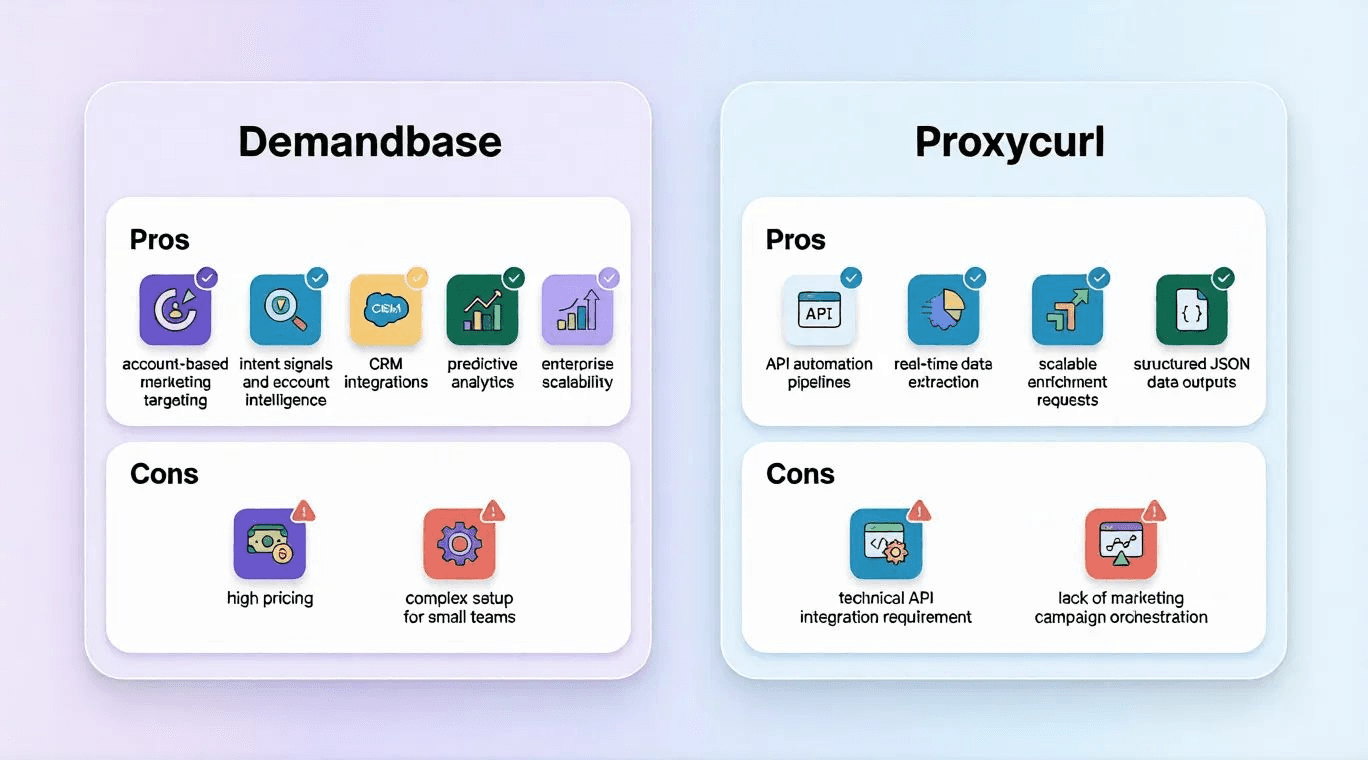
Understanding the advantages and limitations of each platform helps teams make informed decisions. Demandbase and Proxycurl excel in different areas, so weighing their pros and cons clarifies which fits specific workflows.
Demandbase Pros and Cons
Demandbase is the heavy hitter for teams that want a "set-it-and-forget-it" ecosystem for account-based marketing. While it offers unmatched power for identifying high-value accounts before they even reach out, the sheer depth of the platform can be overwhelming for smaller teams without a dedicated RevOps specialist to manage it.
Pros
Strategic ABM focus: Provides account-level insights, intent data, and campaign orchestration.
Marketer-friendly interface: Easy-to-use dashboards and workflows with minimal technical setup.
CRM and MAP integration: Smooth sync with Salesforce, HubSpot, and Marketo.
Predictive insights: AI-driven account scoring and engagement analytics improve targeting efficiency.
Enterprise-ready: Scales across large teams and multiple global markets.
Cons
High cost: Entry-level packages start around $18,000–$32,000 per year.
Contact-level accuracy limitations: Focuses on account intelligence rather than verified individual contacts.
Proxycurl Pros and Cons
Proxycurl is a precision tool built for those who value fresh, raw data over a polished user interface. It provides a level of "just-in-time" accuracy that static databases can't match, though it essentially requires you to build your own dashboard or integrate it into an existing technical stack to get the most value.
Pros
API-first flexibility: Enables custom enrichment pipelines and automation workflows.
Real-time data retrieval: Provides up-to-date profiles and company information on request.
Scalable for any team size: A pay-per-API-credit model enables startups and enterprises to scale efficiently.
Structured outputs: JSON responses simplify integration with CRMs, dashboards, or internal tools.
Cons
Technical knowledge required: API integration demands developer resources and technical expertise.
Limited campaign orchestration: Does not provide ABM dashboards, engagement scoring, or marketing automation tools.
Which One Is a Better Option?
For ABM-driven revenue teams prioritizing account insights, predictive analytics, and intent tracking, Demandbase is a better fit. For teams that need programmatic data access, real-time enrichment, and developer-controlled workflows, Proxycurl is ideal.
However, some teams require a balance: verified contact and company data, multi-provider enrichment, and easy integration without the complexity of building custom pipelines or committing to enterprise ABM contracts. In such cases, FullEnrich subtly fills that gap, offering pay-for-results enrichment with over 20 data sources, giving teams reliable data without extensive technical setup.
Frequently Asked Questions ( FAQs)
Which tool is better for account-based marketing?
Demandbase is better suited for ABM because it provides account scoring, intent data, and campaign orchestration. Proxycurl focuses on raw data enrichment, so it’s less effective for ABM campaign execution.
Can Proxycurl replace Demandbase?
Not entirely. Proxycurl delivers real-time profile and company data via APIs, but it does not provide ABM dashboards, engagement analytics, or intent insights that Demandbase offers.
Which platform is easier to use without technical resources?
Demandbase provides a marketer-friendly interface with dashboards, segmentation, and analytics. Proxycurl requires developer resources to implement APIs and build custom enrichment workflows.
How accurate is the data from each platform?
Demandbase provides high account-level accuracy for firmographics and engagement signals, but limited contact-level verification. Proxycurl delivers real-time profile and company data, but its accuracy depends on source freshness and availability.
Are these tools scalable for growing teams?
Yes, but in different ways. Demandbase scales for enterprise ABM teams across multiple accounts and global markets. Proxycurl scales via API volume, making it flexible for technical growth teams or recruiters handling large datasets.
Can I integrate these platforms with my existing CRM?
Demandbase offers native integrations with Salesforce, HubSpot, and Marketo. Proxycurl integrates via APIs, enabling custom workflows with any CRM that can accept structured data.
Is there a lightweight alternative for verified data without building complex workflows?
Yes. Teams seeking reliable multi-provider enrichment without the complexity of enterprise ABM can consider FullEnrich, which delivers verified contact and company data with pay-for-results pricing.
Which tool is better for recruiting teams?
Proxycurl is more suitable for recruiters because it provides structured people and company data for sourcing, employee lookups, and outreach automation. Demandbase is focused on account-level targeting and ABM campaigns.
Can I use both tools together?
Yes. Teams sometimes use Demandbase for strategic account targeting and Proxycurl to enrich individual contacts within those accounts, combining ABM intelligence with real-time data enrichment.



Other Articles
Cost Per Opportunity (CPO): A Comprehensive Guide for Businesses
Discover how Cost Per Opportunity (CPO) acts as a key performance indicator in business strategy, offering insights into marketing and sales effectiveness.
Cost Per Sale Uncovered: Efficiency, Calculation, and Optimization in Digital Advertising
Explore Cost Per Sale (CPS) in digital advertising, its calculation and optimization for efficient ad strategies and increased profitability.
Customer Segmentation: Essential Guide for Effective Business Strategies
Discover how Customer Segmentation can drive your business strategy. Learn key concepts, benefits, and practical application tips.