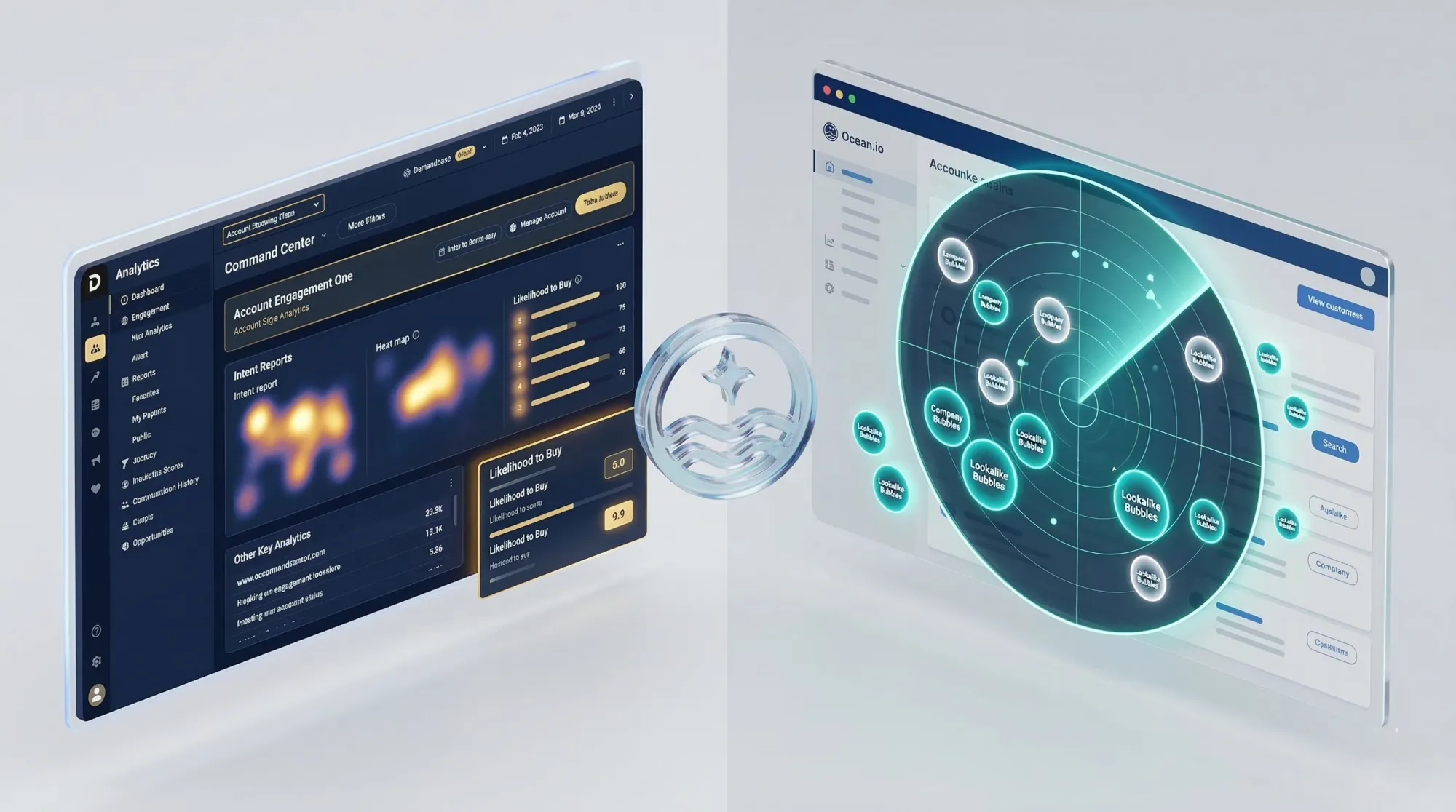

Demandbase and Ocean.io are both account-based marketing (ABM) platforms, but they serve distinct purposes. Demandbase focuses on predictive account engagement, intent signals, and multi-channel ABM, while Ocean.io focuses on data-driven account discovery, lead enrichment, and market research.
If your goal is to prioritize high-value accounts and execute multi-channel ABM campaigns, Demandbase is the stronger choice. If your goal is to discover accounts, enrich leads, and identify market opportunities, Ocean.io is more specialized.
Key Takeaways
Demandbase is a comprehensive Account-Based Marketing (ABM) "Command Center" designed for large-scale enterprise teams. It doesn't just provide data; it uses AI to orchestrate your entire go-to-market strategy. Its real strength lies in its "Pipeline Predict" AI and a native B2B advertising platform that allows you to target the right accounts across the web with surgical precision.
Ocean.io is an agile Account Discovery and Prospecting Engine that focuses on "Lookalike" intelligence. Instead of just searching for generic industries, it allows you to plug in your best customers and find identical companies across the web using AI-powered web scraping. It is built for sales and marketing teams that need to build hyper-focused account lists in minutes.
FullEnrich offers a strategic Waterfall Enrichment approach for teams that are tired of the "no data found" frustration common with single-source tools. While Demandbase and Ocean.io are excellent for identifying accounts, FullEnrich ensures you can actually reach the people inside them by querying over 20+ premium data providers in real-time.
Demandbase vs Ocean.io: Comprehensive Side-by-Side Comparison
Here’s a detailed comparison using the same attributes as previous blogs, highlighting their differences in focus, users, data, and workflow capabilities.
Attributes | Demandbase | Ocean.io |
|---|---|---|
Best For | ABM teams prioritizing high-value account engagement and intent-driven campaigns | Sales and marketing teams focusing on account discovery and data-driven lead enrichment |
Core Focus | Predictive account engagement, intent signals, and multi-channel ABM | Account discovery, lead enrichment, and market research |
Primary Users | Marketing ops, ABM specialists, revenue operations, enterprise sales teams | SDRs, sales reps, marketing teams, business development teams |
Data Source | First-party data, intent signals, proprietary ABM datasets | Public company data, proprietary enrichment datasets, and web intelligence |
Automation Level | High; supports multi-channel campaigns, ABM, and predictive scoring | Moderate; automation for lead enrichment and list generation |
Integration | Salesforce, HubSpot, Marketo, and other ABM platforms | Salesforce, HubSpot, and other CRM or marketing automation tools |
Data Compliance | GDPR, CCPA, and enterprise-level compliance standards | GDPR and CCPA compliant; supports verified enrichment practices |
Pricing Model | Custom Pricing Quotes | Subscription-based; Starts around $47.25/month (billed annually) |
Support | Dedicated account managers, enterprise support, email, and chat | Email support, help centre, documentation, and onboarding assistance |
What is Demandbase?
Demandbase is an account-based marketing (ABM) platform that helps enterprise teams identify, prioritize, and engage high-value accounts. It leverages intent signals, predictive scoring, and multi-channel campaigns to optimize marketing and sales efforts at the account level. Demandbase is ideal for organizations seeking data-driven account prioritization, predictive engagement insights, and automated ABM workflows, rather than individual contact-level enrichment.
What is Ocean.io?
Ocean.io is a data-driven account discovery and lead enrichment platform that helps sales and marketing teams find target companies, enrich lead data, and structure account information for campaigns. It focuses on market research, lead enrichment, and CRM-ready exports rather than multi-channel ABM. Ocean is ideal for organizations that want accurate company profiles, verified contacts, and structured lead lists to feed outbound campaigns or CRM workflows.
What Services Are Offered by Demandbase vs Ocean.io
Demandbase and Ocean serve different purposes within the B2B ABM and lead intelligence ecosystem. Demandbase focuses on account-level insights and engagement, while Ocean focuses on lead enrichment, account discovery, and market research.
Services Offered by Demandbase
Demandbase operates as a strategic partner for enterprise-level organizations, moving beyond simple software access to offer managed services that ensure high-value accounts are properly engaged.
Guided Onboarding & Implementation: Demandbase provides a structured, 60-day service to integrate its platform with your existing CRM and marketing stack. This isn't just a technical setup; it’s a consultative service where their experts help you define your initial target account lists and set benchmarks for success.
Strategic GTM Consultation: They offer ongoing strategic sessions to help revenue leaders refine their "Go-To-Market" (GTM) approach. This service focuses on maturity assessments and roadmap planning, ensuring that your sales and marketing teams stay aligned as your business goals evolve.
Managed Advertising Services: For teams that don't want to manage campaigns internally, Demandbase offers a service in which its experts run B2B-native advertising on your behalf. They handle the audience segmentation and cross-channel execution, using their proprietary data to reach the specific buying groups within your target accounts.
Data Analysis & Insights Coaching: Demandbase provides specialized data services where its analysts help you interpret complex intent signals. They work with your team to surface hidden opportunities in your market and identify "at-risk" customers before they churn, turning raw metrics into actionable sales plays.
Services Offered by Ocean.io
Ocean.io focuses on a "Search-as-a-Service" model, providing high-speed account discovery that feels like having an extra team of researchers.
AI-Powered Account Discovery: The primary service of Ocean.io is the automated identification of "Lookalike" accounts. You provide the name of your best customer, and their service scans the web to find identical companies based on context and business activity rather than just generic industry codes.
Market Expansion Analysis: They offer a service that helps businesses identify which new verticals they should enter next. By analyzing your past "wins" in your CRM, Ocean.io’s engine suggests untapped markets where your product is likely to succeed and provides a prioritized list of accounts to target.
Managed Lead Verification: To protect your sender reputation, Ocean.io provides real-time verification of all contact data. They don't just provide a list; they verify that the emails and phone numbers are active and deliverable before you ever hit "send."
What are the Key Features of Demandbase vs Ocean.io
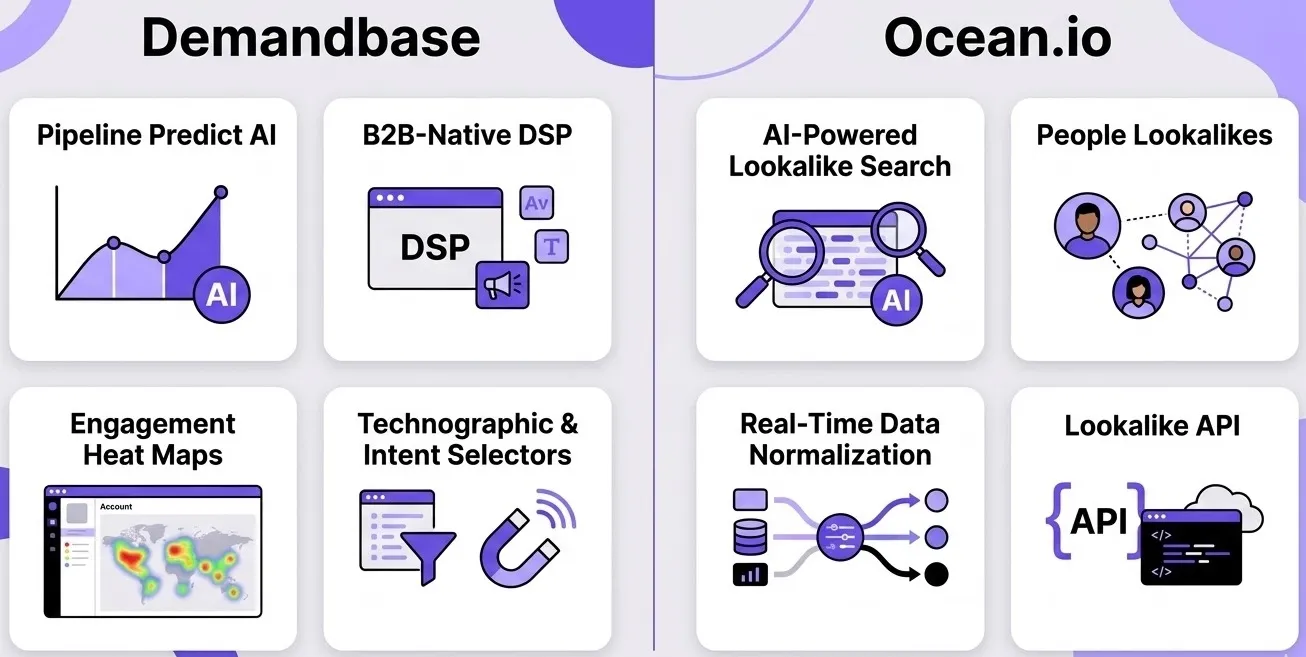
Demandbase and Ocean offer complementary features: Demandbase focuses on account-based marketing, while Ocean focuses on lead enrichment and account discovery.
Key Features of Demandbase
Demandbase’s features are engineered for the enterprise "Revenue Operations" environment. While its services provide the high-level strategy, these technical features act as the gears that connect your marketing data to your sales actions.
Pipeline Predict AI: This is a high-level predictive engine that assigns a "likelihood to buy" score to every account in your CRM. It doesn't just look at who is visiting your site; it uses historical patterns and machine learning to identify which accounts are most likely to convert into an open opportunity within the next 30 days.
B2B-Native DSP (Demand-Side Platform): Demandbase is unique because it includes a built-in advertising engine designed specifically for B2B. This feature allows you to buy ad space across the web that is shown only to the specific companies and job titles on your target list, bypassing the "waste" usually found in general social media advertising.
Engagement Heat Maps: This technical visualization tool breaks down exactly how an account is interacting with your brand. It groups activity by department or persona, allowing you to see if the "IT Team" is researching security while the "C-Suite" is looking at pricing.
Technographic & Intent "Selectors": This feature allows for surgical list building. You can create dynamic lists using "Selectors" that filter for specific technical triggers, for example, "Find all companies in the Northeast using Salesforce that have searched for 'Cloud Security' three times in the last week."
Key Features of Ocean.io
Ocean.io’s features are built around the concept of "Contextual Search." Instead of relying on rigid, outdated industry codes like SIC or NAICS, its features use AI to understand what a company actually does based on how it describes itself.
AI-Powered Lookalike Search: This is the core engine of Ocean.io. You simply paste the URL of your best customer, and the feature uses Natural Language Processing (NLP) to analyze their website, product, and market position. It then finds every other company on the web that "looks and talks" just like them.
People Lookalikes: Similar to the company search, this feature allows you to find specific decision-makers. If you know that "John Doe" was the perfect person to talk to at Company A, this feature scans for people with identical seniority, seniority levels, and responsibilities at your newly discovered lookalike companies.
Real-Time Data Normalization: One of the most useful "under-the-hood" features is its ability to automatically clean up messy data. It takes disparate company information from the web and standardizes it, fixing weird capitalizations, removing legal suffixes like "Inc.", and making sure every entry in your CSV is ready for a personalized email.
The Lookalike API: For teams that build their own internal tools or use platforms like Clay, Ocean.io provides a dedicated API feature. This allows you to automate the lookalike search process at scale, feeding fresh, AI-qualified leads into your outreach systems.
How Accurate Is the Data from Demandbase vs Ocean.io?
Data accuracy is critical for account-based marketing, lead enrichment, and campaign ROI. Demandbase and Ocean.io approach accuracy differently, focusing on distinct data layers: account-level insights versus lead-level enrichment.
Demandbase Data Accuracy
Demandbase is widely regarded as a titan in the enterprise ABM space, specifically for its high-level "Account Intelligence." Because it combines first-party signals with deep third-party intent data, it excels at identifying which companies are surging on specific topics. Its firmographic and technographic data is consistently refreshed, though its true power lies in its "Pipeline Predict AI".
However, because it focuses on the account level, users occasionally find that individual contact data, such as specific direct-dial phone numbers may require secondary verification. According to G2, Demandbase maintains a strong 4.4/5-star rating, praised for its "unmatched intent precision," even though the sheer complexity of the data requires a dedicated ops team to manage it effectively.
Ocean.io Data Accuracy
Ocean.io approaches accuracy through a unique "Lookalike" lens, moving away from generic industry codes that often lead to irrelevant results. Its AI-powered engine analyzes the actual context of a company's website and business activity to find twins of your best customers, which drastically reduces the "false positive" rate common in traditional databases.
While it is incredibly accurate at identifying niche company types that "traditional" filters miss, its contact-level data (emails and phone numbers) is a growing part of the platform.
Which Platform Offers the Most Intuitive User Experience?
User experience determines how efficiently teams can leverage the platform for ABM or lead enrichment workflows. Demandbase focuses on enterprise ABM, while Ocean.io focuses on data-driven account discovery and enrichment.
Demandbase User Experience
Demandbase provides a feature-rich dashboard tailored for ABM teams. Users can track account engagement, monitor intent signals, and orchestrate campaigns across multiple channels from a single interface. Onboarding typically involves integrating with CRM and marketing automation tools, as well as setting up ABM campaigns and scoring models.
Ocean.io User Experience
Ocean provides a clean, user-friendly interface designed for account discovery, lead enrichment, and list generation. Users can search for companies that match ICP criteria, enrich leads with verified email addresses and firmographics, and export structured CSVs for CRM import. Setup is simple, and users can start discovering accounts and enriching leads almost immediately.
Pricing and Plans
Pricing influences accessibility, scalability, and ROI for ABM and lead enrichment tools. Demandbase and Ocean.io follow subscription-based pricing models, but their costs reflect their different focus areas: enterprise ABM vs lead enrichment and account discovery.
Demandbase Pricing Plans
Demandbase follows a "closed-door" pricing model, meaning you won’t find a standard price list on their website. They build custom quotes based on the specific modules you need, whether that’s just the sales intelligence or the full-blown advertising and orchestration cloud.
The Entry Point: For smaller organizations or those seeking a focused setup, the annual cost typically ranges from $18,000 to $32,000.
The Mid-Market Bracket: Companies with around 1,000 employees often see quotes ranging from $45,000 to over $65,000 per year, depending on the volume of accounts being tracked.
Enterprise Scale: For the largest organizations, it’s common for the price to exceed $100,000 annually, with some full-suite deployments reaching the multi-hundred-thousand-dollar range.
Implementation Fees: It’s important to account for a one-time onboarding and setup fee, which can be as high as $29,000 for the first year. This covers the intensive process of syncing their AI with your CRM and training your team on the platform’s advanced features.
Ocean.io Pricing Plans
Ocean.io takes a much more transparent and flexible approach. Their pricing is built on a credit system, where you pay for what you actually use. These credits stay valid for a full 12 months, allowing you to scale your usage up or down depending on your monthly campaign goals.
Starter Plan: For teams just getting their feet wet, you can access approximately 9,000 credits for $47.25 per month when billed annually. This is perfect for maintaining a steady flow of fresh, AI-qualified leads.
Professional/High-Volume Plan: For teams that need to build massive lists, the cost becomes even more efficient at scale. You can secure a package of 60,000 credits for around $260 per month (per volume equivalent) when billed yearly.
Custom Enterprise: If your team requires more than 60,000 credits per year, Ocean.io offers bespoke plans that include higher limits, dedicated account management, and priority support.
Also Read: Ocean.io Pricing and Plans (2025): Is it worth it?
Who Should Use Demandbase vs Ocean.io?
Deciding between these two platforms really comes down to the size of your target list and the complexity of your sales cycle. One is a high-level command center for long-term strategic hunting, while the other is a high-speed discovery engine for finding fresh opportunities.
Who Should Use Demandbase?
Demandbase is built for teams that play the "long game." It’s designed for organizations where a single deal can take six months to a year to close and involves multiple stakeholders across different departments.
Enterprise ABM Specialists: If your marketing strategy revolves around "Account-Based Marketing," Demandbase is your primary dashboard. It helps you treat every high-value account like its own individual market.
Revenue Operations (RevOps) Teams: Ideal for those who need to see the "big picture." Demandbase is perfect for connecting the dots among your website traffic, ad spend, and sales pipeline to see what’s actually working.
Multi-Channel Marketing Teams: If you need to run targeted ads, send personalized emails, and track web engagement all in one place, this platform provides the scale to do it across thousands of accounts.
Sales Teams Targeting "Buying Committees": Perfect for when you aren't just selling to one person, but need to influence the IT manager, the CFO, and the CEO of a target company simultaneously.
Who Should Use Ocean.io?
Ocean.io is for the agile team that needs to find "more customers like their best ones." It’s built for speed and precision, helping you uncover hidden markets that traditional databases usually miss.
SDRs and Individual Prospectors: If your job is to build a fresh list of 100 high-quality leads every Monday morning, Ocean.io’s "lookalike" search is a massive time-saver. It finds the companies that "talk" just like your current happy customers.
Mid-Market Growth Teams: Ideal for companies that want sophisticated targeting without the enterprise-level price tag. It allows you to be surgical in your outreach without needing a dedicated team to manage the software.
Teams Exploring New Verticals: If you’ve been successful in one industry and want to see if your product fits into a similar but different niche, Ocean.io’s AI helps you map out that new territory in minutes.
Data-Driven Sales Reps: Best for reps who are tired of generic "industry filters." If you want to search by what a company actually does rather than just their government-assigned category code, this is your tool.
What are the Pros and Cons of Demandbase vs Ocean.io
Evaluating strengths and limitations helps teams match platform capabilities to business goals. Demandbase focuses on enterprise ABM, while Ocean.io focuses on lead enrichment and account discovery.
Demandbase Pros and Cons
Demandbase is ideal for large ABM teams seeking predictive insights and campaigns.
Pros
Predictive account scoring: Prioritizes high-value accounts based on intent and engagement data.
Multi-channel ABM: Coordinates campaigns across email, display, and web.
Account-level insights: Firmographics, engagement metrics, and historical activity.
Analytics dashboards: Measures ABM performance and ROI.
Enterprise-grade compliance: GDPR, CCPA, and other regulatory standards.
Cons
High starting price: Basic plans start $1,200+/month.
Complex onboarding: Requires CRM integration, ABM strategy, and team training.
What are the Pros and Cons of Ocean.io
Ocean.io is ideal for sales and marketing teams prioritizing actionable lead and account data for campaigns.
Pros
Account discovery engine: Identifies companies that match ICP criteria.
Lead enrichment: Provides verified emails, phone numbers, and firmographic data.
Structured CRM-ready export: Reduces manual formatting for campaigns.
Market research insights: Identifies growth signals and relevant opportunities.
Lower entry cost: Starting at $47.25/month (billed annually), accessible to SMBs and mid-market teams.
Cons
No predictive ABM campaign: Does not manage multi-channel campaigns.
Dependent on existing data quality: Relies on public and proprietary datasets.
Which One Is a Better Option?
If your priority is enterprise ABM and predictive account engagement, Demandbase is the better option. It enables marketing operations, ABM specialists, and revenue teams to prioritize high-value accounts, track intent signals, and orchestrate multi-channel campaigns.
If your priority is data-driven account discovery and lead enrichment, Ocean.io is the stronger choice. It enables sales and marketing teams to identify target companies, enrich leads with verified email addresses and firmographics, and prepare CRM-ready lists for outbound campaigns.
For teams seeking both predictive ABM insights and verified lead-level enrichment, FullEnrich offers a flexible alternative. It combines multi-provider-verified enrichment, real-time validation, and bulk-processing capabilities.
Frequently Asked Questions (FAQs)
Which platform is better for ABM and predictive account engagement?
Demandbase excels in ABM, predictive scoring, and multi-channel campaigns. Ocean.io focuses on account discovery and lead enrichment rather than ABM execution.
Which platform is better for discovering new accounts and leads?
Ocean.io provides actionable company profiles, verified email addresses, and firmographics, making it ideal for sales and marketing teams that need structured account and lead lists.
Can these platforms integrate with CRMs?
Both platforms integrate with CRMs: Demandbase connects for ABM analytics and engagement tracking, while Ocean.io provides CRM-ready CSV exports for seamless lead import.
Do they provide verified email addresses and phone numbers?
Ocean.io offers verified emails and firmographic enrichment. Demandbase focuses on account-level insights and does not provide individual contact verification.
Which platform is suitable for SMBs and mid-market teams?
Ocean.io is ideal for SMB and mid-market teams that need cost-effective account discovery and lead enrichment. Demandbase is best suited for enterprise teams with ABM programs.
Which platform is better for large enterprise ABM campaigns?
Demandbase is built for enterprise ABM, offering predictive account scoring, intent signals, and multi-channel to manage thousands of accounts.
Is there a flexible alternative combining both functionalities?
FullEnrich provides multi-provider verified enrichment, real-time validation, and bulk processing, offering both account-level insights and lead-level actionable data in a single workflow.
Which platform delivers faster results for outbound campaigns?
Ocean.io delivers immediate, actionable lead data for CRM and outbound campaigns, while Demandbase delivers ABM insights that require a multi-channel approach before engagement.



Other Articles
Cost Per Opportunity (CPO): A Comprehensive Guide for Businesses
Discover how Cost Per Opportunity (CPO) acts as a key performance indicator in business strategy, offering insights into marketing and sales effectiveness.
Cost Per Sale Uncovered: Efficiency, Calculation, and Optimization in Digital Advertising
Explore Cost Per Sale (CPS) in digital advertising, its calculation and optimization for efficient ad strategies and increased profitability.
Customer Segmentation: Essential Guide for Effective Business Strategies
Discover how Customer Segmentation can drive your business strategy. Learn key concepts, benefits, and practical application tips.